

Q1
PhysicsEasy
The speed of light in vacuum is taken as unity. If light takes 6 min 40 s to reach the Earth from the Sun, the distance between the Sun and the Earth in new unit is:
Explanation
Time taken by light:
Since the speed of light in vacuum is taken as unity (i.e., ), the distance in the new unit is:
Q2
PhysicsMedium
Match List I with List II:
| List I | List II | |
|---|---|---|
| A. Young's Modulus | I. | |
| B. Compressibility | II. | |
| C. Bulk Modulus | III. | |
| D. Poisson's Ratio | IV. |
Choose the correct answer from the options given below:
Explanation
- A. Young's Modulus = → II
- B. Compressibility = → III
- C. Bulk Modulus = → IV
- D. Poisson's Ratio = → I
Hence the correct match is A-II, B-III, C-IV, D-I.
Q3
PhysicsMediumDiagram
The current in the circuit shown below is:
(All diodes are ideal and identical)
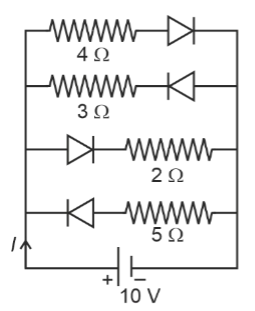 Circuit diagram with diodes and resistors
Explanation
For an ideal diode: forward resistance = 0 and reverse biased resistance = .
Analysing the circuit, the forward-biased diodes short-circuit their respective branches, leaving only the 4 Ω and 2 Ω resistors in parallel across the 10 V battery:
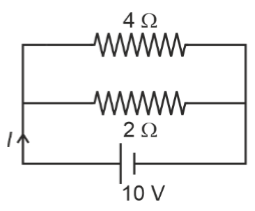 Circuit diagram with diodes and resistors
Q4
PhysicsMedium
The angular speed of a flywheel is increased from 600 rpm to 1200 rpm in 10 s. The number of revolutions completed by the flywheel during this time is:
Explanation
Angular acceleration:
Convert angular velocities:
Using :
Q5
PhysicsMediumDiagram
For a simple pendulum, having time period , the variation of kinetic energy (K.E.) with time () is represented by:
1
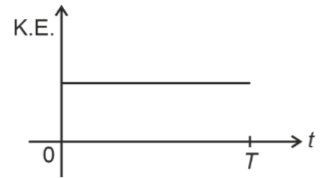 Option 1 graph
2
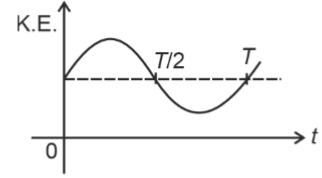 Option 2 graph
3
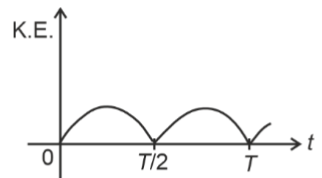 Option 3 graph
4
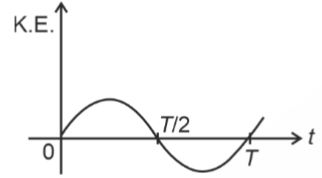 Option 4 graph
Explanation
Kinetic energy of a simple pendulum:
Since is always non-negative and oscillates with a period of , the K.E. vs time graph is always above the time axis, with peaks at and zeros at This matches option (3).
Q6
PhysicsEasyDiagram
A resistor is connected to a battery of 12 V emf and internal resistance 2 Ω. If the current in the circuit is 0.6 A, the terminal voltage of the battery is:
Explanation
Circuit can be draw as,
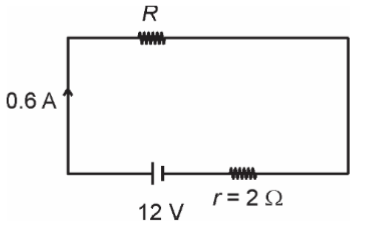 Circuit
Terminal voltage of the battery:
Q7
PhysicsEasy
A flask contains argon and chlorine in the ratio of 2 : 1 by mass. The temperature of the mixture is 27°C. The ratio of root mean square speed of the molecules of the two gases is:
(Atomic mass of argon = 40.0 u and molecular mass of chlorine = 70.0 u)
Explanation
The rms speed is given by:
For the same temperature, . Therefore:
Q8
PhysicsEasyDiagram
A ray of monochromatic light is passing through an equilateral prism (ABC) as shown in the figure. The refracted ray (QR) is parallel to its base (BC) and the angle of incidence () is 50°. Then the angle of deviation () is:
 Equilateral prism diagram
Explanation
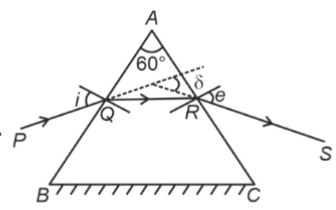 Equilateral prism diagram
Since QR is parallel to the base BC, the ray travels symmetrically through the prism, meaning the angle of emergence .
Using the prism equation:
Q9
PhysicsEasy
Match List I with List II:
| List-I | List-II | |
|---|---|---|
| A. | I. | de Broglie wavelength |
| B. Diffraction and Interference | II. | Particle nature of light |
| C. | III. | Wave nature of light |
| D. Compton effect | IV. | Energy of photon |
Choose the correct answer from the options given below:
Explanation
- A. is the energy of a photon → IV
- B. Diffraction and Interference confirm the wave nature of light → III
- C. is the de Broglie wavelength of a particle → I
- D. Compton effect confirms the particle nature of light → II
Hence the correct match is A-IV, B-III, C-I, D-II.
Q10
PhysicsMedium
In the first excited state of hydrogen atom, the energy of its electron is –3.4 eV. The radial distance of the electron from the hydrogen nucleus in this case is approximately:
Explanation
The potential energy equals twice the total energy in magnitude (by the virial theorem), so:
Q11
PhysicsEasyDiagram
A box of mass 15 kg is kept on the floor of a stationary trolley. The coefficient of static friction between the box and the trolley is 0.12. Keeping the box in stationary state over the trolley, the maximum acceleration with which the trolley can be moved horizontally in m s⁻² is:
Explanation
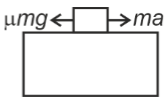 Forces diagram
The maximum static friction provides the net horizontal force on the box:
Q12
PhysicsDifficultDiagram
Five capacitors of capacitances and are connected as shown, along with a battery of 50 V.
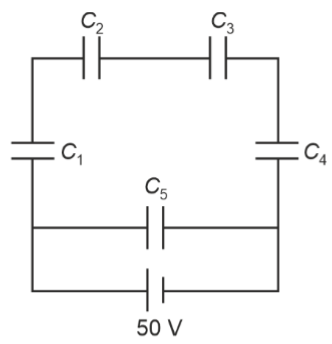 Capacitor circuit diagram
The equivalent capacitance and the charges on each capacitor respectively are:
Explanation
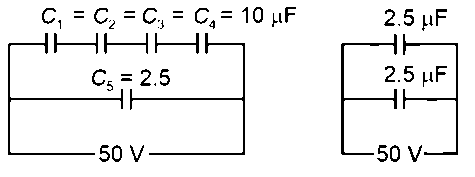 Circuit diagram
From the circuit, , , , (10 µF each) are in series in pairs, giving two series combinations of 5 µF each, which are in parallel giving 10 µF — but this is in series with µF equivalent branch. After full simplification:
Charge on each capacitor:
Hence all five capacitors carry 125 µC each.
Q13
PhysicsEasy
The amount of work done to raise a mass '' from the surface of the Earth to a height equal to the radius of the Earth '' will be:
Explanation
Q14
PhysicsMedium
Each side of a metallic cube of mass 5.580 kg is measured to be 9.0 cm. Keeping the significant figures in view, the density of the material of the cube can be best expressed as kg m⁻³ where the value of is:
Explanation
Since the side measurement (9.0 cm) has only 2 significant figures, the result must be rounded to 2 significant figures:
Q15
PhysicsMediumDiagram
The following plots show variation of velocity () with time () of a ball thrown vertically upward, and falling back. Which of the following plots is/are correct?
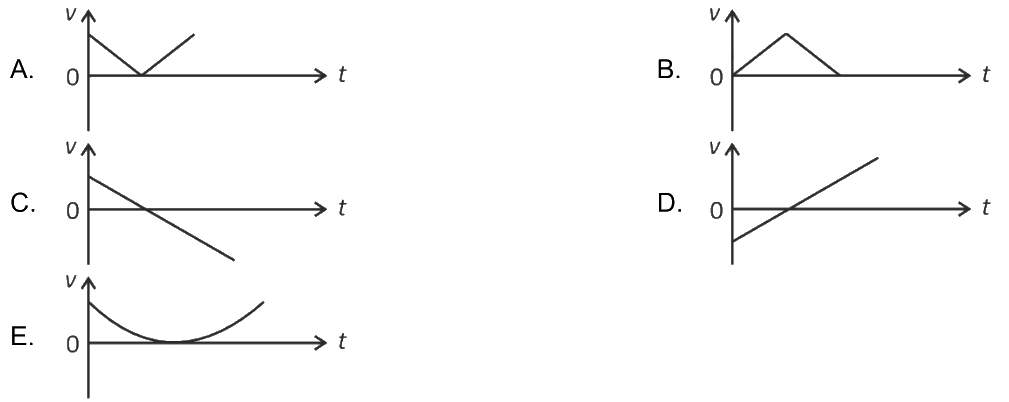 Plot A,B, C, D and E
Explanation
During the entire journey (upward and downward), the acceleration due to gravity acts vertically downward (constant). Therefore, the slope of the velocity vs. time curve must be negative and constant throughout the journey.
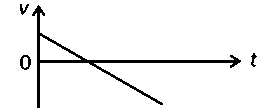 Diagram
The ball starts with a positive velocity (upward), decelerates to zero at the highest point, then accelerates downward (negative velocity). This gives a straight line with a constant negative slope crossing the time axis — which matches plot C.
Q16
PhysicsEasy
The sum of kinetic energy and potential energy of a simple pendulum bob is 0.02 joule. The speed of the simple pendulum bob at equilibrium position is approximately:
(Consider mass of the bob = 20 g)
Explanation
At the equilibrium position, the potential energy is zero, so all the total mechanical energy is kinetic:
Q17
PhysicsDifficult
In Young's double slit experiment, using monochromatic light of wavelength , the intensity of light at a point on the screen where the path difference is , is units. The intensity of light at a point where the path difference is will be:
Explanation
The intensity formula is:
For path difference :
For path difference :
Q18
PhysicsMediumDiagram
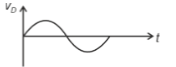
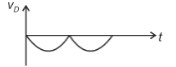
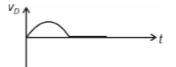
In the circuit shown below, the voltage appearing across the diode D will be of the form:
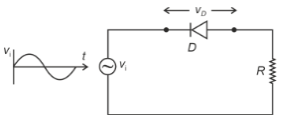 Diode circuit with AC source and resistor
1
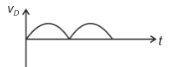 Option 1 waveform
2
 Option 2 waveform
3
 Option 3 waveform
4
 Option 4 waveform
Explanation
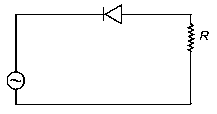 Diode circuit with AC source and resistor
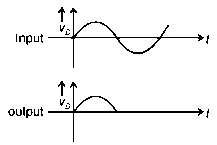
The voltage drop appears across the diode only when it is in reverse bias. In the positive half cycle, the diode is reverse biased — the full positive half of the AC input appears across it. In the negative half cycle, the diode is forward biased (zero resistance), so no voltage drops across it. Thus, shows only the positive half-cycle of the input waveform, which corresponds to option (4).
 Diode circuit with AC source and resistor
Q19
PhysicsMedium
An AC circuit contains a resistance of 1 kΩ, a capacitor of 0.1 µF and an inductor of 1 mH connected in series. The resonance frequency of the circuit is approximately:
Explanation
The resonance frequency of a series LC circuit:
Q20
PhysicsEasy
In interference and diffraction, the light energy is redistributed. If it reduces in one region, producing a dark fringe, it increases in another region, producing a bright fringe.
A. As there is no gain or loss of energy, these phenomena are consistent with the principle of conservation of energy.
B. Diffraction and interference are characteristics exhibited only by light waves.
Choose the correct answer from the options given below:
Explanation
- Statement A is TRUE: In both interference and diffraction, there is no net gain or loss of energy — energy is merely redistributed from dark fringes to bright fringes, consistent with the conservation of energy.
- Statement B is FALSE: Diffraction and interference are wave phenomena exhibited by all types of waves, including sound waves, not just light waves.
Q21
PhysicsMedium
For a travelling harmonic wave
where and are in cm and in s. The phase difference between oscillatory motion of two points separated by a distance of 0.5 m is:
Explanation
Comparing with the standard form, the wave number is:
The phase difference between two points separated by is:
Q22
PhysicsEasyDiagram
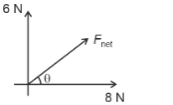
The magnitude and direction of the acceleration produced in a body of mass 5 kg when two mutually perpendicular forces 8 N and 6 N act on it, are respectively:
Explanation
 Solution diagram
Net force:
Acceleration:
Direction with respect to the 8 N force:
Q23
PhysicsMedium
Consider two uncharged capacitors of equal capacitance 200 pF. One of them is charged by a 100 V supply and disconnected. Now this capacitor is connected to the uncharged capacitor. The amount of electrostatic energy lost in the process is:
Explanation
Energy lost when a charged capacitor is connected to an identical uncharged capacitor:
Q24
PhysicsEasy
The power of a crane, which lifts a mass of 1000 kg to a height of 20 m in 10 s is:
Explanation
Q25
PhysicsEasy
In a vernier calliper, 20 VSD coincide with 16 MSD (each division of length 1 mm). The least count of the vernier callipers is:
Explanation
Since :
Q26
PhysicsEasy
When a ruler falls vertically, 5 different persons catch it with different reaction times.
A. Person A has reaction time of 0.20 s.
B. Person B has reaction time of 0.22 s.
C. Person C has reaction time of 0.18 s.
D. Person D has reaction time of 0.19 s.
E. Person E has reaction time of 0.21 s.
What is the correct order of the distance travelled by the ruler for each person?
Explanation
The distance fallen is , which is directly proportional to the square of reaction time. Therefore, greater the reaction time, greater the distance fallen.
Descending order of reaction times:
Hence descending order of distance:
Q27
PhysicsMediumDiagram
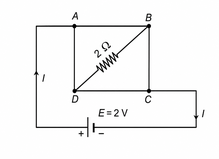
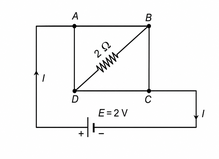
A uniform metallic wire having resistance 4 Ω is bent to form a square loop (ABCD) (see figure). A resistance of 2 Ω is connected between points B and D and a battery of 2 V is connected across points A and C as shown in the figure. Now the value of current () is:
 Square loop Wheatstone bridge circuit
Explanation
 Square loop Wheatstone bridge circuit
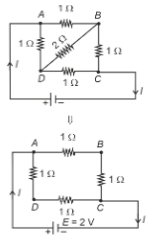
- The total wire resistance is 4 Ω, so each of the four sides has resistance 1 Ω.
- The circuit forms a balanced Wheatstone bridge (each arm = 1 Ω), so no current flows through the 2 Ω resistance between B and D.
- The effective resistance between A and C is two parallel paths of 2 Ω each:
Q28
PhysicsEasy
A room heater is rated 400 W, 220 V. If the supply voltage drops to 200 V, what will be the power consumed (approximately)?
Explanation
The resistance of the heater is fixed. Using :
Q29
PhysicsMedium
A 100-turn closely wound circular coil of radius 5 cm has a magnetic field of T at its centre. The current flowing through the coil, and the magnitude of the magnetic moment of this coil are, respectively:
Take T m/A
Explanation
Magnetic field at centre of a circular coil:
Magnetic moment:
Q30
PhysicsEasy
A rectangular wire loop of sides 8 cm and 3 cm with a small cut, is moving out of a region of uniform magnetic field of magnitude 0.3 T directed normal to the plane of the loop. The emf developed across the cut, if the velocity of the loop is 2 cm s⁻¹, in a direction normal to the shorter side of the loop, will be:
Explanation
The loop moves normal to the shorter side (3 cm), so the effective cutting length is the shorter side:
Q31
PhysicsEasy
Four statements are given ( is mass number):
A. The volume of a nucleus is proportional to .
B. The volume of a nucleus is proportional to .
C. The difference in mass of an atom and its nucleus is called the mass defect.
D. The difference in mass of a nucleus and its constituents is called the mass defect.
Choose the correct answer from the options given below:
Explanation
Nuclear radius: , so , hence . So A is wrong, B is correct.
Mass defect is defined as the difference between the mass of the individual nucleons (protons + neutrons) and the actual mass of the assembled nucleus — not the difference between atom and nucleus. So C is wrong, D is correct.
Q32
PhysicsDifficult
An unknown nucleus has a nuclear density of kg/m³ and mass of kg. Its mass number is approximately:
Take m,
Explanation
Using and :
Q33
PhysicsEasy
Savitha, a XI standard student, while conducting an experiment to determine the effective length of a simple pendulum , notes down the data of time taken to complete 30 oscillations as 60 s and hence calculates the length of the simple pendulum as:
Take , and m/s²
Explanation
Time for 30 oscillations = 60 s, so time period:
Using :
Q34
PhysicsEasy
An electric heater supplies heat to a system at a rate of 100 W. If the system performs work at a rate of 75 J/s, then the rate at which internal energy increases will be:
Explanation
By the first law of thermodynamics:
Q35
PhysicsDifficultDiagram
A thin wire of length '' and linear mass density '' is bent into a circular ring (in x-y plane) with centre '' as shown in figure. The moment of inertia of the ring about an axis will be:
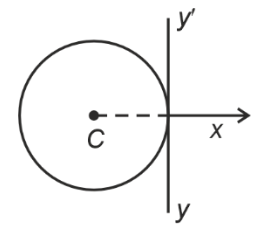 Circular ring in x-y plane with yy' axis
Explanation
Total mass of the wire:
The wire forms a circular ring of circumference , so radius:
Moment of inertia about a diameter (CM axis along ):
Using the parallel axis theorem, the axis passes through the rim (tangent to the circle at one point), at distance from the CM:
Q36
PhysicsEasyDiagram
A galvanometer of resistance 100 Ω gives full scale deflection for a current of 1 mA. It is converted into an ammeter of range 0–10 A. The shunt required is:
Explanation
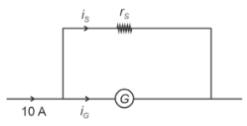 circuit
,
Since the shunt and galvanometer are in parallel:
Q37
PhysicsMediumDiagram
In a metre bridge experiment (see figure), the positions of the cell, , and galvanometer, , are interchanged. We shall observe in the galvanometer:
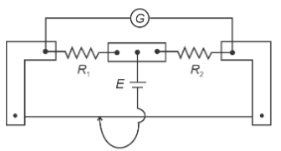 Metre bridge circuit diagram
Explanation
- The position of the null (balance) point does not change when and are interchanged — this is a property of the Wheatstone bridge.
- At the balance point, there will be no deflection in the galvanometer.
- At all other positions of the jockey (unbalanced condition), the galvanometer will show deflection, which can be either left-sided or right-sided depending on the position relative to the null point.
Q38
PhysicsEasy
The peak value of an alternating current is 5 A and frequency is 60 Hz. How long will the current, starting from zero, take to reach the peak value?
Explanation
For current to reach its peak value:
Q39
PhysicsMediumDiagram
The figure given below shows a long straight solid wire of circular cross-section of radius '' carrying steady current . The current is uniformly distributed across its cross-section. The plot which correctly represents the variation of magnetic field () with distance () from the axis of the conductor in the region is:
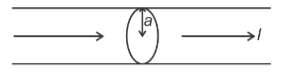 Long straight solid wire cross section
1
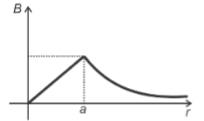 B vs r plot option 1
2
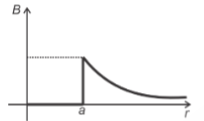 B vs r plot option 2
3
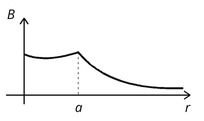 B vs r plot option 3
4
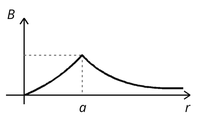 B vs r plot option 4
Explanation
For a long straight solid wire with uniformly distributed current:
- Inside the wire (): (linear increase)
- Outside the wire (): (hyperbolic decrease)
The field increases linearly from the axis, reaches a maximum at , then decreases as . This matches option (1).
Q40
PhysicsEasyDiagram
Two statements are given below:
A. When the forward bias voltage across a p-n junction diode increases above a certain threshold voltage, the diode current increases significantly.
B. This current is called reverse saturation current.
Choose the correct answer from the options given below:
Explanation
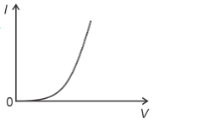 Solution
- Statement A is TRUE: In the V–I characteristic of a forward-biased p-n junction diode, once the forward bias exceeds the threshold (knee) voltage (~0.7 V for Si), the diode current rises sharply.
- Statement B is FALSE: This large forward current is simply called the forward current, not the reverse saturation current. Reverse saturation current is the very small current that flows under reverse bias conditions.
Q41
PhysicsMedium
Which of the following statements are correct?
A. Inside a conductor, the electrostatic field is zero.
B. Electric field at the surface of a charged conductor does not depend on its surface charge density.
C. The interior of a charged conductor can have no excess charge in the static situation.
D. At the surface of a charged conductor, the electrostatic field must be normal to the surface at every point.
E. The electrostatic potential is zero everywhere inside a charged conductor.
Choose the correct answer from the options given below:
Explanation
- A — TRUE: The electrostatic field inside a conductor is zero in the static situation.
- B — FALSE: The electric field at the surface is , which clearly depends on surface charge density .
- C — TRUE: Any excess charge resides only on the surface; the interior has no excess charge in electrostatic equilibrium.
- D — TRUE: The electrostatic field at the surface must be perpendicular (normal) to the surface; a tangential component would cause charge to flow.
- E — FALSE: The electrostatic potential inside a conductor is constant (equal to the surface potential), but it is not necessarily zero.
Hence A, C and D are correct.
Q42
PhysicsMedium
For a metal of work function 6.6 eV, which of the following wavelengths of incident radiation does not give rise to the photoelectric effect?
(Take Planck's constant as J s)
Explanation
For photoelectric effect to occur, the energy of the incident photon must be greater than or equal to the work function of the metal. If , the photoelectric effect does not occur, which means .
Calculating the threshold wavelength:
Any wavelength greater than 187.5 nm will NOT produce the photoelectric effect. Among the options, only 200 nm > 187.5 nm, so option (3) is correct.
Q43
PhysicsEasyDiagram
In a concave lens, a ray of light emanating from the object parallel to the principal axis of the lens after refraction:
Explanation
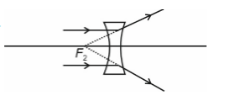 Solution
Note: This question has been marked (2*) indicating a contested/ambiguous answer. The official key awards (2), though technically the ray appears to diverge from the second principal focus (F₂) of a concave lens. The explanation below reflects the official reasoning.
For a concave (diverging) lens:
- F₂ (Second principal focus): The virtual image position for an object at infinity. A ray parallel to the principal axis, after refraction, appears to diverge from F₂ on the same side as the object.
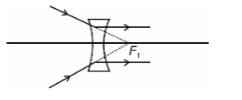 Solution
- F₁ (First principal focus): The virtual object position for which the refracted ray emerges parallel to the principal axis.
A ray parallel to the principal axis, after passing through a concave lens, diverges such that its extension backward appears to come from the second principal focus. The best available option from the given choices is (2), as the paper intended "first principal focus" to mean the focus on the same side as the incoming ray.
Q44
PhysicsEasy
A submarine is designed to withstand an absolute pressure of 100 atm. How deep can it go below the water surface?
(Consider the density of water , and gravitational acceleration )
Explanation
Using the hydrostatic pressure formula:
Q45
PhysicsEasy
Match List I with List II:
| List-I (Electromagnetic wave) | List-II (Production) | ||
|---|---|---|---|
| A. | Microwave | I. | Electrons in atoms emit light when they move from a higher energy level to a lower energy level |
| B. | Visible light | II. | Radioactive decay of nucleus |
| C. | Gamma rays | III. | Vibration of atoms and molecules |
| D. | Infra-red rays | IV. | Klystron valve or magnetron valve |
Choose the correct answer from the options given below:
Explanation
The correct matching is:
- Microwave (A–IV): Produced by Klystron valve or magnetron valve.
- Visible light (B–I): Produced when electrons in atoms transition from a higher to a lower energy level.
- Gamma rays (C–II): Produced by radioactive decay of the nucleus.
- Infra-red rays (D–III): Produced by vibration of atoms and molecules.
Q46
ChemistryMedium
Select the reagents that reduce nitriles to primary amines.
A. (i) LiAlH₄; (ii) H₂O
B. Sn + HCl
C. H₂/Ni
D. Na(Hg)/C₂H₅OH
E. Br₂/aq. NaOH
Choose the correct answer from the options given below.
Explanation
The reagents that reduce nitriles () to primary amines () are:
- A. LiAlH₄ / H₂O: ✓
- C. H₂/Ni: ✓
- D. Na(Hg)/C₂H₅OH: ✓
Reagents that do NOT give primary amines from nitriles:
- B. Sn + HCl: Reduces to an aldehyde (), not a primary amine.
- E. Br₂/aq. NaOH (Hofmann bromamide reaction): This works on amides, not nitriles, to give a primary amine with one less carbon.
Q47
ChemistryEasy
Match List I with List II:
| List I (Transition metal/compound/complex) | List II (Catalytic Role) | ||
|---|---|---|---|
| A. | V₂O₅ | I. | Preparation of ammonia from N₂/H₂ mixture |
| B. | Fe | II. | Polymerisation of alkynes |
| C. | PdCl₂ | III. | Preparation of H₂SO₄ and SO₂ |
| D. | Ni complex | IV. | Oxidation of ethyne to ethanal |
Choose the correct answer from the options given below.
Explanation
- V₂O₅ (A–III): Catalyses the oxidation of SO₂ to SO₃ in the Contact Process for manufacture of H₂SO₄.
- Fe (B–I): Acts as catalyst in the Haber process for preparation of ammonia from N₂/H₂ mixture.
- PdCl₂ (C–IV): Catalyses the Wacker oxidation — oxidation of ethyne to ethanal.
- Ni complex (D–II): Catalyses polymerisation of alkynes.
Q48
ChemistryDifficult
Consider the following reaction:
at 298 K.
Identify the correct option with for the reaction and spontaneity of the reaction at 298 K.
(Given: )
Explanation
For the reaction :
First, calculate from :
Then, calculate :
Since , the reaction is non-spontaneous under standard conditions. Option (3) is closest to the calculated value.
Q49
ChemistryEasy
Match List I with List II:
| List I (Quantum Numbers) | List II (Orbital) | |||
|---|---|---|---|---|
| 'n' | 'l' | |||
| A. | 2 | 1 | I. | 3d |
| B. | 4 | 0 | II. | 2p |
| C. | 5 | 3 | III. | 4s |
| D. | 3 | 2 | IV. | 5f |
Choose the correct answer from the options given below.
Explanation
The azimuthal quantum number identifies the subshell: , , , . The orbital name is formed by combining with the subshell letter:
- A: → 2p (II)
- B: → 4s (III)
- C: → 5f (IV)
- D: → 3d (I)
Hence: A–II, B–III, C–IV, D–I → Option (3).
Q50
ChemistryDifficult
In a qualitative analysis, Bi³⁺ is detected by appearance of precipitate of BiO(OH)(s). Calculate pH when the following equilibrium exists at 298 K.
(Given: )
Explanation
Let the solubility be . Since BiO(OH) is a pure solid, its activity is 1:
So M.
Q51
ChemistryEasy
The correct statement with regard to the secondary structure of DNA/RNA is:
Explanation
- DNA has a double-stranded helix secondary structure (Watson-Crick model) consisting of two polynucleotide chains wound around each other. Its four nitrogenous bases are Adenine (A), Guanine (G), Cytosine (C), and Thymine (T).
- RNA is typically single-stranded and contains Uracil (U) instead of thymine. It does not have thymine.
Options (1), (3), and (4) are incorrect because they either assign the wrong base or the wrong strand structure to DNA/RNA.
Q52
ChemistryMediumDiagram
The pair of molecules that are metamers among the following is:
1
CH₃CH₂CH₂OH and CH₃–CH(OH)–CH₃
2
CH₃CH₂CH₂CH₂CH₃ and (CH₃)₂CHCH₂CH₃
3
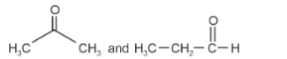 q52_option3
4
CH₃OCH₂CH₂CH₃ and CH₃CH₂OCH₂CH₃
Correct answerExplanation
Metamerism is a type of structural isomerism that arises due to different alkyl groups on either side of the same functional group in compounds belonging to the same homologous series.
- Option (1): These are position isomers (both alcohols, –OH at different positions), not metamers.
- Option (2): These are chain isomers (both alkanes with different carbon skeletons).
- Option (3): These are functional group isomers (a ketone and an aldehyde).
- Option (4): (methyl propyl ether) and (diethyl ether) — both are ethers with the same molecular formula but different alkyl groups on either side of the –O– group. These are metamers.
Q53
ChemistryMediumDiagram
Match List I with List II:
| List-I (Complex) | List-II (Type of isomerism) | ||
|---|---|---|---|
| A. | [Pt(NH₃)₂Cl₂] | I. | Optical |
| B. | [Co(en)₃]³⁺ | II. | Solvate |
| C. | [Co(NH₃)₅NO₂]Cl₂ | III. | Geometrical |
| D. | [Cr(H₂O)₆]Cl₃ | IV. | Linkage |
Choose the correct answer from the options given below:
Explanation
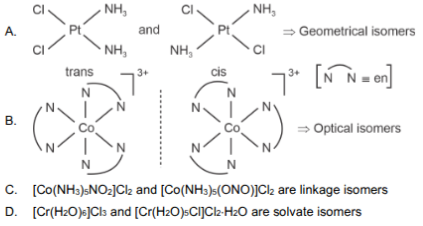 Solution
- [Pt(NH₃)₂Cl₂] (A–III): Exists as cis and trans forms → Geometrical isomerism.
- [Co(en)₃]³⁺ (B–I): The tris(ethylenediamine) cobalt(III) complex is non-superimposable on its mirror image → Optical isomerism.
- [Co(NH₃)₅NO₂]Cl₂ (C–IV): The nitrite ligand (NO₂⁻) can coordinate through N (nitro) or O (nitrito) → Linkage isomerism. Its linkage isomer is [Co(NH₃)₅(ONO)]Cl₂.
- [Cr(H₂O)₆]Cl₃ (D–II): Can exist as [Cr(H₂O)₅Cl]Cl₂·H₂O where a water molecule is replaced by Cl in the coordination sphere → Solvate (ionisation) isomerism.
Q54
ChemistryEasy
Match List I with List II:
| List-I (Order of reaction) | List-II (Unit of rate constant) | ||
|---|---|---|---|
| A. | Zero order | I. | mol⁻¹ L s⁻¹ |
| B. | First order | II. | mol⁻² L² s⁻¹ |
| C. | Second order | III. | s⁻¹ |
| D. | Third order | IV. | mol L⁻¹ s⁻¹ |
Choose the correct answer from the options given below:
Explanation
The unit of rate constant for an order reaction is:
- Zero order (): → (IV)
- First order (): → (III)
- Second order (): → (I)
- Third order (): → (II)
Hence: A–IV, B–III, C–I, D–II → Option (2).
Q55
ChemistryMediumDiagram
The correct IUPAC name of the following compound is:
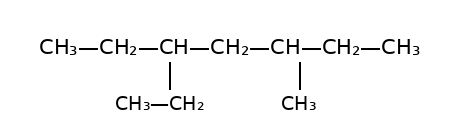 Question 55
Explanation
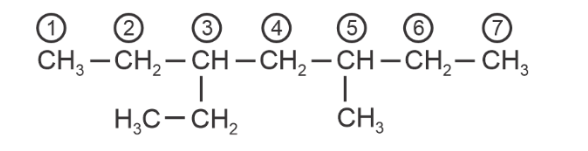 Solution.
Numbering from the end that gives lowest locants to substituents:
Substituents are listed in alphabetical order (ethyl before methyl):
IUPAC name: 3-ethyl-5-methylheptane
Q56
ChemistryEasy
A bulb is rated at 150 watt, converting 8% energy into light. If energy of one photon is J, how many photons are emitted by the bulb per second?
Explanation
Total energy consumed per second =
Energy converted to light:
Number of photons emitted:
Hence, approximately photons are emitted per second.
Q57
ChemistryEasy
Methane reacts with steam at 1273 K in the presence of nickel catalyst to form:
Explanation
The steam reforming reaction of methane:
This reaction is used industrially for the preparation of dihydrogen (syngas). The products are carbon monoxide and hydrogen gas.
Q58
ChemistryDifficultDiagram
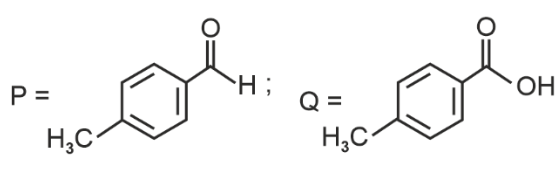
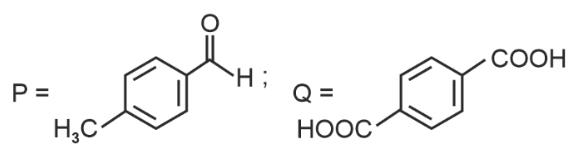
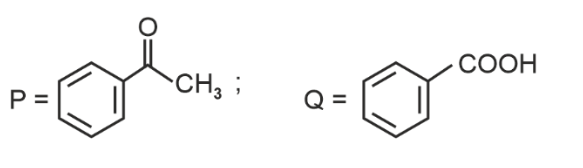
Compound P (C₈H₈O) gives a red orange precipitate with 2,4-DNP reagent and it does not reduce Fehling's reagent. On drastic oxidation with chromic acid, P gives an aromatic product Q that produces effervescence on treating with aq. NaHCO₃. Compounds P and Q, respectively, are:
1
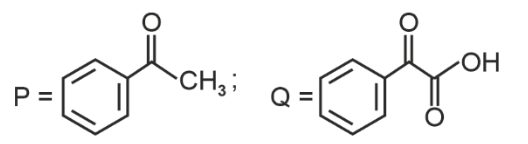 q58_option1
2
 q58_option2
3
 q58_option3
4
 q58_option4
Explanation
Degree of unsaturation
Five degrees of unsaturation suggest an aromatic ring (4 degrees) plus one additional degree (C=O).
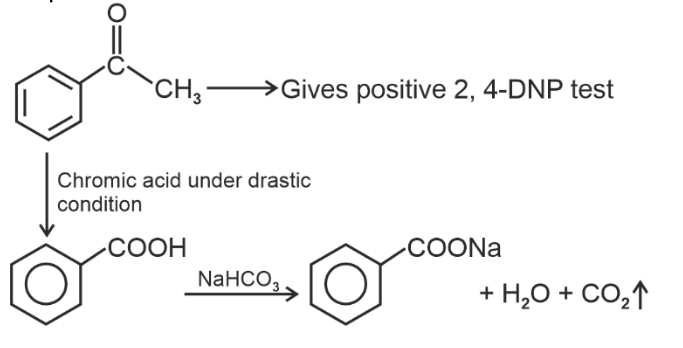 Solution.
Q59
ChemistryEasy
Match List I with List II:
| List I | List II | ||
|---|---|---|---|
| A. | C₂H₄ | I. | 3 σ bonds, 2 π bonds |
| B. | C₂H₂ | II. | 3 σ bonds, one lone pair |
| C. | CH₄ | III. | 4 σ bonds |
| D. | NH₃ | IV. | 5 σ bonds, 1 π bond |
Choose the correct answer from the options given below:
Explanation
- C₂H₄ (ethylene): Structure . Has 5 σ bonds (4 C–H + 1 C–C) and 1 π bond → (IV)
- C₂H₂ (acetylene): Structure . Has 3 σ bonds (2 C–H + 1 C–C) and 2 π bonds → (I)
- CH₄ (methane): Structure has 4 σ bonds (4 C–H), no π bonds → (III)
- NH₃ (ammonia): Structure has 3 σ bonds (3 N–H) and one lone pair → (II)
Hence: A–IV, B–I, C–III, D–II → Option (2).
Q60
ChemistryMedium
The following two reactions give the same foul smelling product Z.
X and Z, respectively, are:
Explanation
Route 1: (ethyl isocyanide — foul smelling)
AgCN is a covalent silver salt that reacts through the carbon of CN⁻, giving the isocyanide (R–NC). KCN (ionic) reacts through nitrogen to give the nitrile (R–CN).
Route 2:
The Hofmann bromamide reaction converts an amide to a primary amine (Y), and the carbylamine reaction (CHCl₃/KOH) converts a primary amine to an isocyanide (Z) — the characteristic foul-smelling product.
Therefore: X = AgCN, Z = C₂H₅NC.
Q61
ChemistryEasy
The number of hydrogen atoms present in 5.4 g of urea is:
(Given: Molar mass of urea: 60 g mol⁻¹; particles mol⁻¹)
Explanation
Structure of urea: → 4 hydrogen atoms per molecule.
Moles of urea:
Number of hydrogen atoms:
Q62
ChemistryMedium
Identify the incorrect statement from the following:
Explanation
- Option (1) — Correct: Nitrogen, due to its small atomic size, can effectively form pπ–pπ multiple bonds with itself (e.g., N≡N in N₂).
- Option (2) — Correct: Phosphorus and Arsenic have vacant d-orbitals, allowing them to form dπ–dπ back-bonds with transition metals.
- Option (3) — Correct: Phosphorus, arsenic, and antimony all show catenation (formation of chains of like atoms), unlike nitrogen which has limited catenation.
- Option (4) — Incorrect: Neither nitrogen nor oxygen possesses d-orbitals (both are in Period 2). Therefore, dπ–pπ bonding between nitrogen and oxygen is not possible.
Q63
ChemistryEasy
Which one of the following is an ambidentate ligand?
Explanation
An ambidentate ligand is one that has two different donor atoms, either of which can coordinate to the metal centre in a complex.
- Ethane-1,2-diamine (en): Didentate — donates through both N atoms (same type). Not ambidentate.
- EDTA (Ethylenediaminetetraacetate ion): Hexadentate — donates through 2N and 4O atoms, but all bonds form simultaneously. Not ambidentate.
- Thiocyanate (SCN⁻): Can coordinate through S (forming thiocyanato, M–SCN) or through N (forming isothiocyanato, M–NCS). This is the classic ambidentate ligand. ✓
- Oxalate (C₂O₄²⁻): Didentate — always coordinates through both O atoms. Not ambidentate.
Q64
ChemistryEasy
The correct order of increasing metallic character of Na, Be, P, Mg and Si is:
Explanation
Metallic character is inversely proportional to electronegativity. Using Pauling electronegativity values:
| Element | Electronegativity |
|---|---|
| Na | 0.9 |
| Mg | 1.2 |
| Be | 1.5 |
| Si | 1.8 |
| P | 2.1 |
Higher electronegativity → lower metallic character. Therefore, increasing metallic character:
This is consistent with the periodic trends: metallic character decreases left to right across a period and increases top to bottom in a group.
Q65
ChemistryDifficultDiagram
Match List I with List II:
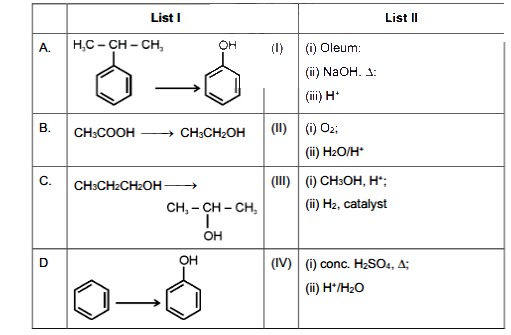 Question 65
Choose the correct answer from the options given below:
Explanation
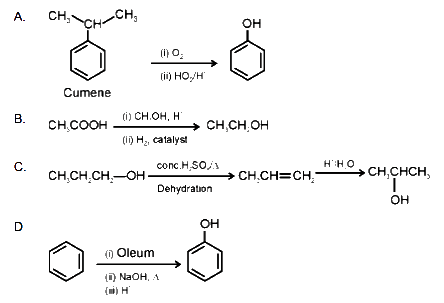 Solution 65
- A (Cumene → Phenol): Reagents (II) — Cumene (isopropylbenzene) is oxidised by O₂ to cumene hydroperoxide, which on acid hydrolysis (H₂O/H⁺) gives phenol and acetone. This is the Cumene process.
- B (CH₃COOH → CH₃CH₂OH): Reagents (III) — Acetic acid is first esterified with CH₃OH/H⁺ to give methyl acetate, then catalytic hydrogenation (H₂, catalyst) reduces the ester to give ethanol (and methanol).
- C (CH₃CH₂CH₂OH → CH₃CH(OH)CH₃): Reagents (IV) — n-Propanol undergoes dehydration with conc. H₂SO₄/Δ to give propene, which is then hydrated via Markovnikov addition (H⁺/H₂O) to give 2-propanol (isopropyl alcohol).
- D (Benzene → Phenol): Reagents (I) — Benzene is sulfonated with oleum to give benzenesulphonic acid, which is then fused with NaOH/Δ (alkali fusion) and acidified (H⁺) to yield phenol.
Q66
ChemistryEasy
Although +3 oxidation state is most common in lanthanoids, cerium still shows +4 oxidation state because:
Explanation
Cerium (Ce) has the electronic configuration [Xe] 4f¹ 5d¹ 6s².
- In the +3 state, Ce³⁺ configuration is [Xe] 4f¹ — one electron remains in the f-subshell.
- In the +4 state, Ce⁴⁺ configuration is [Xe] 4f⁰ — the f-subshell is completely empty.
An empty f-subshell (4f⁰) represents an extra stability (similar to how a completely filled or half-filled subshell confers stability). This is why cerium uniquely exhibits the +4 oxidation state among early lanthanoids — losing that one extra electron achieves the stable 4f⁰ configuration. Option (3) is also wrong because atomic number 61 is Promethium, not Cerium (Ce = 58).
Q67
ChemistryMedium
In the following reaction sequence, X and Z respectively are:
Explanation
Step 1:
So X = POCl₃ (phosphorus oxychloride).
Step 2: — elimination (dehydrohalogenation).
Step 3:
The peroxide initiates free radical addition of HBr, which follows anti-Markovnikov addition. The Br attaches to the terminal (less substituted) carbon:
So Z = CH₃CH₂CH₂Br (1-bromopropane).
Q68
ChemistryEasy
Match List I with List II:
| List I (Complex/ion) | List II (Shape/geometry) | ||
|---|---|---|---|
| A. | [Pt(Cl₂)(NH₃)₂] | (I) | Octahedral |
| B. | [Co(NH₃)₆]Cl₃ | (II) | Trigonal bipyramidal |
| C. | [NiCl₄]²⁻ | (III) | Square planar |
| D. | [Fe(CO)₅] | (IV) | Tetrahedral |
Choose the correct answer from the options given below:
Explanation
- [Pt(Cl₂)(NH₃)₂] (A–III): Pt²⁺ undergoes dsp² hybridisation → Square planar geometry.
- [Co(NH₃)₆]Cl₃ (B–I): Co³⁺ undergoes d²sp³ hybridisation → Octahedral geometry.
- [NiCl₄]²⁻ (C–IV): Ni²⁺ undergoes sp³ hybridisation (Cl⁻ is a weak field ligand) → Tetrahedral geometry.
- [Fe(CO)₅] (D–II): Fe undergoes dsp³ hybridisation → Trigonal bipyramidal geometry.
Q69
ChemistryEasy
The functional group that can be identified through phthalein dye test is:
Explanation
Phthalein Dye Test: When phenol is heated with phthalic anhydride in the presence of concentrated H₂SO₄ (as a catalyst), a colourless condensation product called phenolphthalein is formed. On treatment with NaOH (alkaline medium), phenolphthalein turns pink/red — this is a characteristic positive test for the phenolic (–OH on aromatic ring) functional group.
This test is specific to phenols and does not give a positive result with simple alcohols, aldehydes, or carboxylic acids.
Q70
ChemistryMediumDiagram
Two products X and Y are formed in the following reaction sequence.
 Benzene
The suitable method that can be used for the separation of products X and Y is:
Explanation
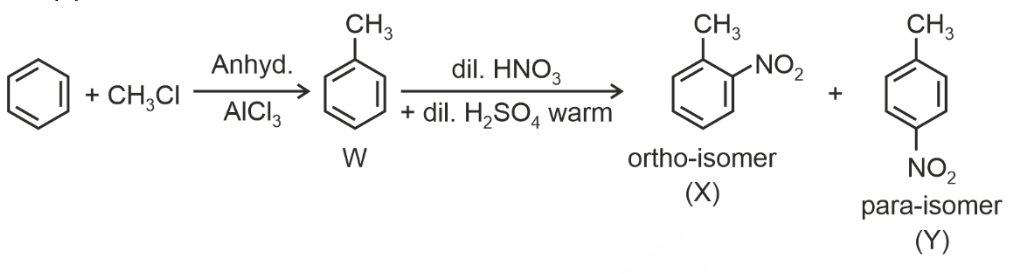 Solution.
The reaction proceeds as:
- Benzene + CH₃Cl / AlCl₃ (Friedel-Crafts alkylation) → Toluene (W)
- Toluene + dil. HNO₃ + dil. H₂SO₄ (mild nitration) → ortho-nitrotoluene (X) + para-nitrotoluene (Y)
The two isomers differ significantly in their boiling points:
- ortho-isomer: M.P. = –4°C, B.P. = 222°C
- para-isomer: M.P. = 54°C, B.P. = 238°C
Since both are liquids at room temperature (o-isomer) or a low-melting solid (p-isomer) with distinct boiling points, they are separated by fractional distillation under reduced pressure.
Q71
ChemistryMedium
Identify the correct statements:
(A) The molality of 2.5 g of ethanoic acid (Molar mass: 60 g mol⁻¹) in 75 g of benzene solution is 0.556 m.
(B) The molarity of a solution containing 5 g of NaOH (molar mass: 40 g mol⁻¹) in 450 mL of solution is 0.278 M at 298 K.
(C) Aquatic species are more comfortable in cold water.
(D) The solubility of gas increases with decrease in pressure.
(E) For a binary mixture of A and B, the number of moles of A and B are and respectively. The mole fraction of B will be .
Choose the correct answer from the options given below:
Explanation
(A) Correct:
(B) Correct:
(C) Correct: According to Henry's Law, and . As temperature decreases, decreases and the solubility of gases increases. More dissolved O₂ in cold water makes aquatic species more comfortable. ✓
(D) Incorrect: Henry's Law states , so solubility is directly proportional to pressure. As pressure increases, solubility increases; as pressure decreases, solubility decreases. ✗
(E) Incorrect: The mole fraction of B is , not . ✗
Q72
ChemistryEasy
During Lassaigne's test, the elements present in an organic compound are converted from:
Explanation
In an organic compound, heteroatoms like N, S, and halogens are bonded through covalent bonds. During Lassaigne's test, the organic compound is fused with sodium metal at high temperature. This converts the covalently bonded elements into their ionic forms in the sodium fusion extract:
- N → NaCN (ionic)
- S → Na₂S (ionic)
- Halogens → NaX (ionic, e.g. NaCl, NaBr)
These ionic species are then identified by further wet chemical tests. Hence the conversion is covalent → ionic.
Q73
ChemistryMedium
A solution of copper sulphate is electrolysed for 10 minutes with a current of 1.5 amperes. The mass of copper deposited at cathode is:
(Given: Molar mass of Cu = 63 g mol⁻¹; 1 F = 96487 C mol⁻¹)
Explanation
At the cathode:
Using Faraday's second law (electrochemical equivalent):
Q74
ChemistryEasy
At a certain temperature, T (K), during a process, 500 J is absorbed by the system and work of 200 J is done by the system. Then change in internal energy of the system is:
Explanation
Using the First Law of Thermodynamics:
Sign conventions:
- Heat absorbed by system:
- Work done by the system: (system loses energy by doing work)
Q75
ChemistryEasyDiagram
For a certain reaction R → Product, the plot of concentration [R] vs time has a negative slope as shown. The order of reaction is:
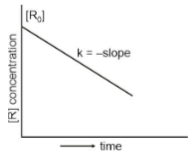 q75_main
Explanation
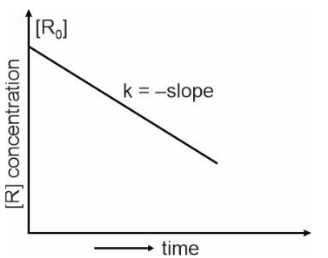 Solution.
For a zero-order reaction, the integrated rate law is:
This is a linear equation in the form , where the plot of [R] vs. time gives a straight line with a negative slope equal to . The graph shown (a straight line with negative slope) is characteristic of a zero-order reaction.
For first-order reactions, the [R] vs. time plot would be exponential (curved), not linear.
Q76
ChemistryMedium
Identify the correct statement about ClF₃ from the following options:
Explanation
In ClF₃:
- Cl has 7 valence electrons; 3 are used for bonding with F; remaining 4 form 2 lone pairs.
- Total electron pairs around Cl = 3 (bond pairs) + 2 (lone pairs) = 5 → sp³d hybridisation → parent geometry: trigonal bipyramidal.
- The 2 lone pairs occupy the equatorial positions to minimise repulsion, leaving the 3 F atoms in axial-equatorial arrangement.
- The resulting molecular geometry is T-shaped (bent T-shape).
Hence ClF₃ has T-shaped geometry with two lone pairs on the Cl atom.
Q77
ChemistryEasy
In a test tube containing a salt, a few drops of dilute H₂SO₄ was added, which gave colourless vapours having the smell of vinegar. The vapours turned the blue litmus paper red.
Identify the correct anion from the following:
Explanation
When dilute H₂SO₄ is added to an acetate salt:
Acetic acid (CH₃COOH) is released as a colourless vapour with the characteristic smell of vinegar. Being an acid, it turns blue litmus red.
Other options are ruled out:
- S²⁻ + H₂SO₄ → H₂S (rotten egg smell, not vinegar)
- SO₄²⁻ gives no gas with dilute H₂SO₄
- CO₃²⁻ → CO₂ (odourless gas, but turns lime water milky, not vinegar smell)
Q78
ChemistryMedium
At 298 K, a certain buffer solution contains equal concentrations of X⁻ and HX. for X⁻ is . What is the pH of this buffer solution?
Explanation
X⁻ is the conjugate base of the weak acid HX. Using the relationship:
Using the Henderson–Hasselbalch equation for the buffer:
Since (given):
Q79
ChemistryDifficult
Calculate emf of the half cell given below:
(Given: , )
Explanation
The half-cell reaction (oxidation at anode):
Applying the Nernst equation:
With , , :
Q80
ChemistryEasy
The calculated 'spin-only' magnetic moment of Ti²⁺ (3d²) is:
Explanation
Spin-only magnetic moment formula:
where = number of unpaired electrons.
Electronic configuration of Ti²⁺: [Ar] 4s⁰ 3d²
In the 3d² configuration, both electrons occupy separate d-orbitals (Hund's rule), so .
Q81
ChemistryMedium
Identify the incorrect statement from the following:
Explanation
- Option (1) — Correct: Carbon forms pπ–pπ multiple bonds with itself, as seen in C=C (ethylene) and C≡C (acetylene).
- Option (2) — Correct: BCl₃ exists as a monomer (B has no d-orbitals for back-bonding and is a smaller atom). AlCl₃ exists as a dimer (Al₂Cl₆) in the solid/vapour state via coordinate bonds using Al's empty orbital.
- Option (3) — Correct: Catenation decreases down Group 14: C >> Si > Ge ≈ Sn, due to decreasing M–M bond strength.
- Option (4) — Incorrect: Oxygen exhibits multiple oxidation states: 0 (in O₂), –1 (in peroxides like H₂O₂, Na₂O₂), –½ (in superoxides), and –2 (in most oxides). It does not show only –2. Hence statement (4) is incorrect.
Q82
ChemistryDifficultDiagram
The correct formal charges on oxygen atoms numbered 2, 1 and 3 respectively are:
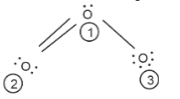 q82_main
Explanation
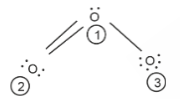 Solution.
The formula for formal charge is:
where V = valence electrons, S = shared (bonding) electrons, L = lone pair (non-bonding) electrons.
From the Lewis structure of ozone (O₃):
- Oxygen atom 2 (single-bonded O with lone pairs): →
- Oxygen atom 1 (central O): →
- Oxygen atom 3 (double-bonded terminal O): →
Hence, formal charges on atoms 2, 1, and 3 respectively: 0, +1, –1.
Q83
ChemistryEasy
Phenolphthalein is used as an indicator for the titration of sodium hydroxide solution against a standard solution of oxalic acid. The colour change that is observed at an alkaline pH close to the equivalence point during this titration is:
Explanation
This is a titration of a strong base (NaOH) against a weak acid (oxalic acid). NaOH is taken in the burette and oxalic acid is the standard solution.
- Before equivalence point: The solution is acidic (excess oxalic acid) → Phenolphthalein is colourless in acid.
- At/near equivalence point: The solution becomes alkaline (NaOH is in excess as the last drop is added) → Phenolphthalein turns pink.
Therefore, the colour change at the equivalence point is: colourless → pink.
Q84
ChemistryMedium
When 1 dm³ of CO₂ gas is passed over hot coke the volume of gaseous mixture after complete reaction at STP becomes 1.4 dm³. The composition of the gaseous mixture at STP is:
Explanation
The reaction is:
Let dm³ of CO₂ react:
| CO₂ | CO | |
|---|---|---|
| Initial | 1 | 0 |
| Change | –x | +2x |
| Final | 1–x | 2x |
Total volume after reaction =
- Volume of CO₂ remaining =
- Volume of CO formed =
Q85
ChemistryMediumDiagram
The major product Z formed in the following sequence of reactions is:
 Question.
Explanation
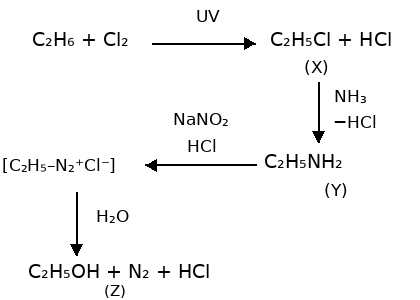 Solution.
Q86
ChemistryMedium
Given below is an expression for the rate constant of a first-order reaction occurring at a certain temperature, T (K).
The energy of activation in kcal mol⁻¹ for the reaction is:
(Given: k in s⁻¹, R = 1.987 cal mol⁻¹ K⁻¹)
Explanation
Comparing with the Arrhenius equation in logarithmic form:
By direct comparison with the given expression :
Q87
ChemistryEasy
Given below are certain reactions. Identify the reaction for which .
Explanation
The relationship between and is:
only when . If , then .
Calculating (moles of gaseous products – moles of gaseous reactants):
| Reaction | vs | |
|---|---|---|
| (1) H₂O + CO ⇌ H₂ + CO₂ | 2 – 2 = 0 | |
| (2) N₂ + 3H₂ ⇌ 2NH₃ | 2 – 4 = –2 | |
| (3) H₂ + I₂ ⇌ 2HI | 2 – 2 = 0 | |
| (4) N₂ + O₂ ⇌ 2NO | 2 – 2 = 0 |
Only reaction (2) has , so .
Q88
ChemistryMedium
Identify the incorrect statement from the following:
Explanation
- Option (1) — Incorrect: Among Mg, Mg²⁺, Al, and Al³⁺, the largest species is Mg (neutral atom, no charge, more electrons) and the smallest is Al³⁺ (highest charge-to-size ratio, maximum electron removal). The statement claims smallest is Mg²⁺, which is wrong. ✗
- Option (2) — Correct: Element 107 = Bohrium (Bh). Its IUPAC systematic name is Unnilseptium (Un=1, nil=0, sept=7 → 107). ✓
- Option (3) — Correct: Li (Period 2, Group 1) and Mg (Period 3, Group 2) are diagonally placed in the periodic table and show similar properties — this is the diagonal relationship. ✓
- Option (4) — Correct: In [AlCl(H₂O)₅]²⁺, Al has oxidation state +3 and is coordinated to 1 Cl⁻ and 5 H₂O, giving a coordination number (covalency) of 6. ✓
Q89
ChemistryEasy
Mixture of chloroform and acetone forms a solution with negative deviation from Raoult's law due to:
Explanation
When acetone and chloroform are mixed, the C=O group of acetone forms hydrogen bonds with the C–H of chloroform (which is made acidic due to the three electron-withdrawing Cl atoms):
These intermolecular attractions between unlike molecules are stronger than the interactions in the pure components. As a result:
- The escaping tendency of molecules decreases.
- The vapour pressure of the mixture is lower than that predicted by Raoult's law → negative deviation.
- The boiling point of the mixture is higher than either pure component.
Q90
ChemistryMediumDiagram
The number of chlorine atoms present in the organic products X and Y of the following reactions, respectively, are:
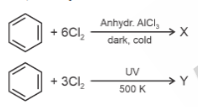 Solution.
Explanation
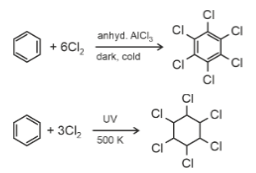 Solution.
Reaction 1 — Electrophilic Aromatic Substitution (AlCl₃ catalyst):
Benzene + 6Cl₂ with anhydrous AlCl₃ (dark, cold) undergoes electrophilic substitution of all 6 ring hydrogens to give hexachlorobenzene (C₆Cl₆), which has 6 Cl atoms.
Reaction 2 — Free Radical Addition (UV light, 500 K):
Benzene + 3Cl₂ under UV light undergoes free radical addition across the double bonds of the ring to give benzene hexachloride (BHC / lindane, C₆H₆Cl₆), which also has 6 Cl atoms.
Both products X and Y contain 6 chlorine atoms each.
Q91
BiologyEasy
In angiosperms, root hairs arise from which one of the following regions of the root?
Explanation
The root tip is organized into distinct zones from tip to base:
- Root cap: Protects the growing tip.
- Region of meristematic activity: Actively dividing cells.
- Region of elongation: Cells elongate, pushing the root tip forward.
- Region of maturation: Cells differentiate. Some epidermal cells extend outward to form very fine, delicate, thread-like structures called root hairs, which greatly increase the absorptive surface area of the root.
Root hairs arise exclusively from the region of maturation (also called the zone of differentiation).
Q92
BiologyEasy
In which one of the following, the ovules are not enclosed by an ovary wall and remain exposed?
Explanation
The key distinction is between gymnosperms and angiosperms:
- Gymnosperms ("naked-seeded"): Ovules are not enclosed by an ovary wall and remain exposed, both before and after fertilisation.
- Angiosperms ("enclosed-seeded"): Ovules are enclosed within the ovary.
Among the options:
- Pinus is a gymnosperm → ovules are exposed and not enclosed. ✓
- Funaria is a moss (Bryophyte) → does not produce ovules in the angiosperm sense.
- Selaginella is a pteridophyte → produces megaspores within megasporangia, not true ovules.
- Wolffia is the smallest flowering plant — an angiosperm → ovules enclosed.
Q93
BiologyEasy
In the lac operon, the z gene codes for:
Explanation
The lac operon consists of a regulatory gene (i) and three structural genes (z, y, a), each coding for a specific enzyme involved in lactose metabolism:
| Gene | Enzyme/Protein |
|---|---|
| i | Repressor protein (regulatory) |
| z | β-galactosidase (cleaves lactose → glucose + galactose) |
| y | Permease (facilitates lactose entry into cell) |
| a | Transacetylase |
Hence, the z gene codes for beta-galactosidase.
Q94
BiologyEasy
Exploring molecular, genetic and species-level diversity for products of economic importance is called:
Explanation
- Bioprospecting: The systematic exploration of molecular, genetic, and species-level diversity (especially in biodiversity hotspots) to discover products of economic importance such as new drugs, enzymes, and agrochemicals. ✓
- Biofortification: Breeding crops with higher levels of nutrients (vitamins, minerals) to improve nutritional value.
- Bioremediation: Use of microorganisms to clean up environmental pollutants.
- Biomagnification: Progressive increase in concentration of a pollutant as it moves up the food chain.
Q95
BiologyEasy
Match List I with List II:
| List-I | List-II | ||
|---|---|---|---|
| A. | Genetically modified organism | (I) | Agrobacterium tumefaciens |
| B. | Thermostable DNA polymerase | (II) | Bt cotton |
| C. | Ti plasmid | (III) | Thermus aquaticus |
| D. | pBR322 | (IV) | Escherichia coli |
Choose the correct answer from the options given below:
Explanation
- Genetically modified organism (A–II): Bt cotton is a well-known GMO containing genes from Bacillus thuringiensis for insect resistance.
- Thermostable DNA polymerase (B–III): Taq polymerase, used in PCR, is derived from the thermophilic bacterium Thermus aquaticus.
- Ti plasmid (C–I): The tumour-inducing (Ti) plasmid is naturally found in the soil bacterium Agrobacterium tumefaciens and is used as a vector in plant genetic engineering.
- pBR322 (D–IV): This is one of the first artificial cloning vectors, constructed from sequences found in Escherichia coli.
Q96
BiologyEasy
Match List I with List II:
| List I | List II | ||
|---|---|---|---|
| A. | Productivity | I. | Gross primary productivity minus respiration losses |
| B. | Net primary productivity | II. | Rate of formation of new organic matter by consumers |
| C. | Gross primary productivity | III. | Rate of biomass production |
| D. | Secondary productivity | IV. | Rate of production of organic matter during photosynthesis |
Choose the correct answer from the options given below:
Explanation
- Productivity (A–III): The general rate of biomass production in an ecosystem.
- Net primary productivity (B–I): (Gross primary productivity minus respiration losses). It represents the biomass available to consumers.
- Gross primary productivity (C–IV): The total rate of production of organic matter during photosynthesis by producers (including what is used in respiration).
- Secondary productivity (D–II): The rate of formation of new organic matter by consumers (heterotrophs) through assimilation of food.
Q97
BiologyEasy
Since the origin and diversification of life on Earth, there have been five episodes of mass extinction of species. How is the sixth extinction, which is in progress, different from the previous episodes?
Explanation
The current (sixth) mass extinction event is unprecedented in its rate and cause:
- It is estimated to be proceeding at 100 to 1000 times faster than the extinction rates observed in pre-human times.
- Unlike the previous five mass extinction events (caused by natural events such as asteroid impacts, volcanic eruptions, or climate shifts), the sixth extinction is primarily driven by human activities — habitat destruction, overexploitation, invasive species introduction, pollution, and climate change.
Q98
BiologyEasy
Alpha-helix is found in which level of protein structure?
Explanation
The levels of protein structure and their features:
- Primary structure: Linear sequence of amino acids linked by peptide bonds.
- Secondary structure: Local folding patterns stabilised by hydrogen bonds between backbone atoms. The two major types are the α-helix (right-handed spiral coil) and the β-pleated sheet.
- Tertiary structure: Overall 3D folding of the entire polypeptide chain (ball-like / globular conformation); stabilised by various interactions including disulfide bridges, hydrophobic interactions, etc.
- Quaternary structure: Association of two or more polypeptide chains (subunits) into a functional complex (e.g., haemoglobin).
The α-helix is a feature of the secondary structure.
Q99
BiologyEasy
The main function of bulliform cells in grasses is:
Explanation
Bulliform cells (also called motor cells) are large, empty, thin-walled, colourless epidermal cells found in the upper epidermis of grass leaves, arranged in groups.
During water stress (drought conditions), bulliform cells lose water, become flaccid, and cause the leaf to curl inward (roll up). This reduces the exposed surface area of the leaf, thereby minimising water loss through transpiration. When water is available again, they become turgid and the leaf unrolls.
Q100
BiologyEasy
Identify the correct sequence of steps in each cycle of Polymerase Chain Reaction:
Explanation
Each cycle of PCR (Polymerase Chain Reaction) consists of three steps performed at specific temperatures:
- Denaturation (~94°C): The double-stranded DNA template is heated to separate (denature) the two strands by breaking hydrogen bonds.
- Annealing (~50–65°C): The temperature is lowered to allow specific primers (short synthetic oligonucleotides) to hybridise (anneal) to their complementary sequences on each single-stranded template.
- Extension (~72°C): Taq DNA polymerase extends the primers by adding dNTPs in the 5'→3' direction, synthesising new complementary strands.
The correct sequence is: Denaturation → Annealing → Extension.
Q101
BiologyEasy
Match List I with List II:
| List-I (Phase of cell cycle) | List-II (Activity) | ||
|---|---|---|---|
| A. | G₁ phase | I. | Actual cell division occurs |
| B. | S phase | II. | Cell is metabolically active and continuously grows but does not replicate its DNA |
| C. | G₂ Phase | III. | Synthesis of DNA occurs and the amount of DNA per cell doubles |
| D. | M phase | IV. | Proteins are synthesized while cell growth continues |
Choose the correct answer from the options given below:
Explanation
The cell cycle consists of interphase (G₁, S, G₂) and mitotic phase (M):
- G₁ phase (A–II): The cell is metabolically active and grows continuously but does not replicate its DNA. This is the first gap phase.
- S phase (B–III): DNA synthesis (replication) takes place; the amount of DNA per cell doubles (from 2N to 4N).
- G₂ phase (C–IV): Proteins (especially tubulin for spindle) are synthesised in preparation for mitosis; cell growth continues.
- M phase (D–I): The actual cell division (mitosis + cytokinesis) occurs.
Q102
BiologyMedium
Which of the following statements are correct?
A. The Amazon rainforest being cut and cleared for cultivation of soyabeans is an example of habitat loss.
B. Steller's sea cow and passenger pigeon became extinct due to over-exploitation by humans.
C. The Nile perch introduced into Lake Victoria in East Africa helped in population growth of cichlid fish in the lake.
D. Water hyacinth is an invasive species.
E. When a species becomes extinct, the plant and animal species associated with it are not affected.
Choose the correct answer from the options given below:
Explanation
- A — Correct: Clearing the Amazon rainforest for soyabean cultivation is a classic example of habitat loss and fragmentation, the most important cause of biodiversity loss. ✓
- B — Correct: Steller's sea cow (hunted to extinction by 1768) and the passenger pigeon (extinct by 1914 due to large-scale hunting) are examples of extinction caused by over-exploitation. ✓
- C — Incorrect: The Nile perch introduced into Lake Victoria did not help cichlid fish; it caused the extinction of more than 200 species of ecologically unique cichlid fish. ✗
- D — Correct: Eichhornia crassipes (water hyacinth) is a notorious invasive alien species that clogs waterways and causes ecological damage. ✓
- E — Incorrect: When a species becomes extinct, the plant and animal species associated with it in an obligatory way also become extinct (co-extinctions). ✗
Q103
BiologyMedium
Which of the following statements are correct with reference to a transcription unit?
A. A transcription unit in DNA is defined primarily by three regions: promoter, structural gene and terminator.
B. The promoter is said to be located towards the 5'-end of the structural gene.
C. The promoter is a DNA sequence that provides binding site for RNA polymerase.
D. The promoter defines the template and coding strands.
E. The terminator is located towards the 3'-end of the coding strand and it defines the end of the process of transcription.
Choose the correct answer from the options given below:
Explanation
All five statements are correct:
- A: A transcription unit is indeed defined by three regions — promoter, structural gene, and terminator. ✓
- B: The promoter is located towards the 5'-end of the structural gene (upstream). ✓
- C: The promoter provides the binding site for RNA polymerase, which is the first step in transcription initiation. ✓
- D: The orientation of the promoter determines which strand is used as the template strand (read 3'→5') and which is the coding strand (non-template, has same sequence as mRNA except T→U). ✓
- E: The terminator is located at the 3'-end of the coding strand and signals the end of transcription. ✓
Q104
BiologyEasy
Which one of the following statements is not true about the universal rules of binomial nomenclature?
Explanation
The universal rules of binomial nomenclature (ICBN/ICZN) include:
- Names are in Latin (or Latinised). ✓ (Option 1 is true)
- When handwritten, both words are separately underlined; when printed, they are in italics. ✓ (Option 2 is true)
- The specific epithet (second word) starts with a small/lowercase letter. ✓ (Option 3 is true)
- Option 4 is FALSE: In binomial nomenclature, the first word represents the genus (starts with a capital letter) and the second word represents the specific epithet (starts with a small letter). The statement reverses these — it is incorrect.
Q105
BiologyEasy
Match List I with List II:
| List-I | List-II | ||
|---|---|---|---|
| A. | Decomposition | I. | Accumulation of dark coloured amorphous colloidal substance |
| B. | Detritus | II. | Release of inorganic nutrients by the activity of microbes in soil |
| C. | Mineralisation | III. | Breaking down of complex organic matter into inorganic substances |
| D. | Humification | IV. | Dead remains of plants and animals including fecal matter |
Choose the correct answer from the options given below:
Explanation
- Decomposition (A–III): The process of breaking down complex organic matter (detritus) into simpler inorganic substances by decomposers (bacteria and fungi).
- Detritus (B–IV): The raw material for decomposition — dead remains of plants and animals including fecal matter.
- Mineralisation (C–II): The degradation of humus further by microbes, leading to the release of inorganic nutrients (mineral ions) into the soil.
- Humification (D–I): The process leading to the accumulation of dark coloured amorphous colloidal substance called humus. Humus is highly resistant to microbial action and acts as a nutrient reservoir.
Q106
BiologyEasy
Which one of the following is the site for active ribosomal RNA synthesis?
Explanation
The nucleolus is a prominent, non-membrane-bound structure found within the nucleus. It is the site of:
- Active ribosomal RNA (rRNA) synthesis (transcription of rDNA by RNA Pol I).
- Ribosome assembly — rRNA combines with ribosomal proteins imported from the cytoplasm to form ribosomal subunits, which are then exported to the cytoplasm.
The nucleolus is associated with the nucleolar organiser region (NOR) on specific chromosomes.
Q107
BiologyMedium
The Respiratory Quotient (RQ) of a biomolecule used for respiration, as per the above equation would be:
Explanation
From the given equation:
- CO₂ evolved = 102 volumes
- O₂ consumed = 145 volumes
This value lies between 0.5 and 0.95, which is characteristic of fats undergoing aerobic respiration. The molecular formula has a high H:O ratio compared to carbohydrates, confirming it is a fat (triglyceride). Fats require proportionally more O₂ for complete oxidation, hence RQ < 1.
Q108
BiologyEasy
Match List I with List II:
| List-I | List-II | ||
|---|---|---|---|
| A. | Incomplete dominance | I. | Human skin colour |
| B. | Co-dominance | II. | Inheritance of flower colour in Antirrhinum sp. |
| C. | Pleiotropy | III. | Phenylketonuria disease in humans |
| D. | Polygenic inheritance | IV. | ABO blood groups |
Choose the correct answer from the options given below:
Explanation
- Incomplete dominance (A–II): In Antirrhinum sp. (snapdragon), crossing red (RR) and white (rr) flowers gives pink (Rr) offspring — the heterozygote shows an intermediate phenotype. Classic example of incomplete dominance.
- Co-dominance (B–IV): In ABO blood groups, individuals with genotype (AB blood group) express both A and B antigens simultaneously — neither allele is dominant.
- Pleiotropy (C–III): Phenylketonuria (PKU) — a single gene mutation (PAH enzyme deficiency) leads to multiple phenotypic effects (intellectual disability, fair skin, musty odour, etc.).
- Polygenic inheritance (D–I): Human skin colour is controlled by multiple (at least three) pairs of non-allelic genes, producing a continuous range of phenotypes.
Q109
BiologyMedium
Arrange the following steps of DNA fingerprinting in a correct sequence.
A. Isolation of DNA and its digestion by restriction endonucleases.
B. Hybridisation using a labelled VNTR probe.
C. Transferring of separated DNA fragments to synthetic membranes.
D. Detection of hybridised DNA fragments by autoradiography.
E. Separation of DNA fragments by electrophoresis.
Choose the correct answer from the options given below:
Explanation
The correct sequence of steps in DNA fingerprinting (based on Southern blotting technique) is:
- A — Isolation of DNA from the sample, followed by digestion using specific restriction endonucleases into fragments of varying sizes.
- E — Separation of DNA fragments by gel electrophoresis (based on size — smaller fragments travel farther).
- C — Transferring (blotting) the separated DNA fragments from the gel to synthetic membranes (nylon or nitrocellulose) — Southern blotting.
- B — Hybridisation of the membrane-bound DNA fragments with a labelled VNTR (Variable Number of Tandem Repeats) probe.
- D — Detection of hybridised DNA fragments by autoradiography (X-ray film) to produce the DNA fingerprint pattern.
Correct sequence: A → E → C → B → D
Q110
BiologyMedium
Which of the following statements are correct with reference to packaging of DNA helix?
A. Histones are organized to form a unit of eight molecules called histone octamer.
B. Histones are negatively charged basic proteins.
C. Histones are rich in the basic amino acid residues — lysine and arginine.
D. The positively charged DNA is wrapped around the histone octamer to form nucleosome.
E. The packaging of chromatin at higher levels requires an additional set of proteins called non-histone chromosomal proteins.
Choose the correct answer from the options given below:
Explanation
- A — Correct: Eight histone molecules (2 each of H2A, H2B, H3, H4) are organised to form the histone octamer. ✓
- B — Incorrect: Histones are positively charged (due to their richness in basic amino acids with –NH₂ groups), not negatively charged. ✗
- C — Correct: Histones are rich in lysine and arginine — basic amino acids that carry positive charges at physiological pH. ✓
- D — Incorrect: DNA is negatively charged (due to phosphate groups) and is wrapped around the positively charged histone octamer. The statement reverses the charges. ✗
- E — Correct: Packaging of chromatin at higher levels (30 nm fibre, loops, etc.) requires non-histone chromosomal (NHC) proteins. ✓
Correct statements: A, C and E.
Q111
BiologyMedium
Find the incorrect statement(s) about photosynthesis from the following:
A. The water splitting complex is associated with PS I.
B. C₄ plants use the C₃ pathway of CO₂ fixation as the main biosynthetic pathway.
C. In C₄ plants, photorespiration does not occur.
D. C₃ plants exhibit 'Kranz' anatomy.
E. ATP synthesis in chloroplast occurs through chemiosmosis.
Choose the answer from the options given below:
Explanation
Evaluating each statement:
- A — Incorrect: The water splitting complex (oxygen-evolving complex, OEC) is associated with PS II (Photosystem II), not PS I. ✗
- B — Correct: C₄ plants do use the C₃ pathway (Calvin cycle) as the main biosynthetic (carbon fixation) pathway in bundle sheath cells. The C₄ pathway (Hatch-Slack) only serves to concentrate CO₂. ✓
- C — Correct: In C₄ plants, the high CO₂ concentration in bundle sheath cells (due to C₄ pumping) effectively suppresses photorespiration (oxygenase activity of RuBisCO is minimised). ✓
- D — Incorrect: Kranz anatomy (wreath-like arrangement of bundle sheath cells) is a characteristic of C₄ plants, not C₃ plants. ✗
- E — Correct: ATP synthesis in chloroplasts (photophosphorylation) occurs via chemiosmosis — proton gradient across the thylakoid membrane drives ATP synthase (CF₀-CF₁ complex). ✓
Incorrect statements: A and D → Answer is (4).
Q112
BiologyMedium
Arrange the following steps of somatic hybridisation in a correct sequence.
A. Digestion of cell walls.
B. Isolation of naked protoplasts.
C. Fusion of protoplasts to get hybrid protoplast.
D. Isolation of single cells from two different varieties of plants.
E. Growing of hybrid protoplast to form a new plant.
Choose the correct answer from the options given below:
Explanation
Somatic hybridisation is the fusion of protoplasts from two different plant varieties to create a somatic hybrid. The correct sequence is:
- D — Isolation of single cells from two different varieties of plants (each with a desirable character).
- A — Digestion of cell walls using cellulase and pectinase enzymes.
- B — Isolation of naked protoplasts (cells surrounded only by the plasma membrane).
- C — Fusion of protoplasts (chemically using PEG, or electrically) to get hybrid protoplast.
- E — Growing of hybrid protoplast in culture medium to form a new hybrid plant (somatic hybrid).
Correct sequence: D → A → B → C → E
Q113
BiologyEasy
Match List-I with List-II:
| List-I | List-II | ||
|---|---|---|---|
| A. | Conjunctive tissue | I. | Specialised cells in the vicinity of guard cells |
| B. | Casparian strips | II. | Endodermal cells rich in starch |
| C. | Subsidiary cells | III. | Tissue between xylem and phloem |
| D. | Starch sheath | IV. | Endodermal cells with suberin deposition |
Choose the correct answer from the options given below:
Explanation
- Conjunctive tissue (A–III): The parenchymatous tissue found between xylem and phloem in the roots of monocots (and sometimes dicots). It is called conjunctive tissue because it joins (connects) the vascular bundles.
- Casparian strips (B–IV): Bands of suberin deposited in the radial and transverse walls of endodermal cells. They prevent apoplastic movement of water/solutes into the vascular cylinder.
- Subsidiary cells (C–I): Specialised epidermal cells surrounding and in the vicinity of guard cells, forming the stomatal apparatus. They assist in regulating stomatal opening/closing.
- Starch sheath (D–II): Another name for the innermost layer of the cortex (endodermis) in stems where the endodermal cells are rich in starch grains.
Q114
BiologyEasy
Which one of the following is not a characteristic of plant cells in the phase of elongation?
Explanation
The region of elongation in the root (just above the meristematic zone) is characterised by:
- New cell wall deposition ✓ (cells deposit new wall material to accommodate growth)
- Cell enlargement ✓ (cells increase in size, pushing the root tip forward)
- Increased vacuolation ✓ (large central vacuoles develop, drawing in water and causing elongation)
Large conspicuous nuclei are a feature of the region of meristematic activity (apical meristem), where cells are small, have dense cytoplasm, and large nuclei relative to cell size. In the elongation zone, nuclei become relatively smaller compared to the growing cell.
Q115
BiologyEasy
Match List-I with List-II:
| List-I (Growth Regulator) | List-II (Function/Effect) | ||
|---|---|---|---|
| A. | 2,4-D | I. | Brewing industry |
| B. | GA₃ | II. | Stimulation of stomatal closure |
| C. | Kinetin | III. | Herbicide |
| D. | ABA | IV. | Nutrient mobilisation |
Choose the correct answer from the options given below:
Explanation
- 2,4-D (A–III): 2,4-Dichlorophenoxyacetic acid is a synthetic auxin used as a weedicide/herbicide to kill broad-leaved weeds in cereal crops.
- GA₃ / Gibberellic acid (B–I): Used in the brewing industry to stimulate production of α-amylase in barley seeds for malting (converting starch to sugar for fermentation). Also used to speed up malting process.
- Kinetin (C–IV): A cytokinin that promotes nutrient mobilisation (directs movement of amino acids, sugars, and other nutrients towards the cytokinin-rich region — the "sink effect").
- ABA / Abscisic acid (D–II): Known as the "stress hormone"; causes stomatal closure during water stress by triggering efflux of K⁺ from guard cells, causing them to become flaccid.
Q116
BiologyEasy
The enzyme required for carboxylation in the Calvin cycle is
Explanation
RuBisCO (RuBP carboxylase-oxygenase) is the enzyme required for carboxylation in the Calvin cycle. It catalyses the fixation of CO₂ to RuBP (Ribulose-1,5-bisphosphate) to form two molecules of 3-phosphoglycerate (3-PGA).
- Hexokinase phosphorylates glucose in glycolysis.
- PEP carboxylase is involved in C₄ and CAM pathways, not in the Calvin cycle's carboxylation step.
- Carboxypeptidase is a proteolytic enzyme that cleaves amino acids from the C-terminus of proteins.
Q117
BiologyMedium
How many ATP and NADPH molecules are required to make one molecule of glucose through the Calvin pathway?
Explanation
Each turn of the Calvin pathway utilizes 3 ATP and 2 NADPH+H⁺ molecules for the fixation of 1 CO₂ molecule. Since 6 turns are required to synthesize 1 molecule of glucose (fixing 6 CO₂):
Hence, 18 ATP and 12 NADPH+H⁺ are required for glucose synthesis.
Q118
BiologyMediumDiagram
Which of the following floral formula is the correct floral formula of Solanaceae family?
1
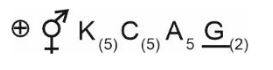 q118_option1.png
2
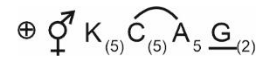 q118_option2.png
3
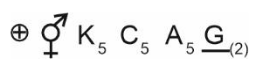 q118_option3.png
4
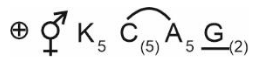 q118_option4.png
Explanation
The floral formula for Solanaceae is:
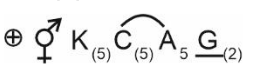 Solution.
- Actinomorphic (⊕): radially symmetrical flower.
- Bisexual (♀♂): both stamens and pistil present.
- Gamosepalous : 5 sepals fused.
- Gamopetalous : 5 petals fused (the arc over C indicates fusion).
- Epipetalous : 5 stamens attached to petals.
- Bicarpellary syncarpous, superior ovary : 2 fused carpels with superior ovary.
In Solanaceae, both calyx (K) and corolla (C) show fusion (gamosepalous and gamopetalous condition), so the formula must display brackets around both 5s. Option (3) and (4) lack brackets on K or C, and option (1) lacks the arc (fusion mark) on C.
Q119
BiologyEasy
Which of the following is an in situ conservation method?
Explanation
In situ conservation refers to the conservation of species within their natural habitat.
- Sacred Groves are patches of forest that are protected by local communities for religious or cultural reasons — this is a classic example of in situ conservation.
- Wildlife Safari Parks, Botanical Gardens, and Seed Banks are examples of ex situ conservation, where organisms or their germplasm are maintained outside their natural habitat.
Q120
BiologyMedium
Which of the following statements are not true regarding restriction endonucleases?
A. They are called molecular scissors.
B. These are the enzymes responsible for restricting the growth of bacteriophages in E. coli.
C. They cut the DNA only at the centre of the palindromic sites.
D. They remove nucleotides only from the ends of DNA fragments.
E. They recognise specific palindromic base-pair sequences.
Choose the answer from the options given below:
Explanation
Statements C and D are not true:
- C is incorrect: Restriction endonucleases do not cut exactly at the centre of palindromic sites. They typically cut slightly away from the centre, generating either blunt ends or sticky (cohesive) ends.
- D is incorrect: Removing nucleotides from the ends of DNA fragments is the function of restriction exonucleases, not endonucleases.
Statements A, B, and E are correct:
- They are indeed called molecular scissors (A).
- They were originally discovered as enzymes that restrict bacteriophage growth in E. coli (B).
- They recognize specific palindromic base-pair sequences (E).
Q121
BiologyEasy
In racemose inflorescence, _________.
Explanation
In racemose type of inflorescence, the main axis continues to grow indefinitely (indeterminate growth) and the flowers are borne laterally in an acropetal succession (older flowers at the base, younger towards the apex).
In contrast, in cymose inflorescence, the main axis terminates in a flower (limited/determinate growth), which is described by options (1) and (3). Option (2) describes solitary flowers, which is not a feature of racemose inflorescence.
Q122
BiologyEasy
Arrange the following in the correct developmental sequence related to microsporogenesis:
A. Microspore tetrads
B. Sporogenous tissue
C. Pollen grains
D. Pollen mother cells
Choose the correct answer from the options given below:
Explanation
Microsporogenesis is the process of formation of microspores from a pollen mother cell (PMC) through meiosis.
The correct developmental sequence is:
- Sporogenous tissue differentiates into pollen mother cells.
- Pollen mother cells (PMC) undergo meiosis to form microspore tetrads.
- Microspore tetrads separate into individual microspores that mature into pollen grains.
Q123
BiologyEasy
Identify the correct statements about biomolecules.
A. Lipids are generally water soluble.
B. Proteins are polypeptides.
C. Polysaccharides are long chains of sugars.
D. Adenine and guanine are substituted pyrimidines.
E. Almost all enzymes are proteins.
Choose the correct answer from the options given below:
Explanation
Statements B, C, and E are correct:
- B: Proteins are polymers of amino acids linked by peptide bonds — they are polypeptides.
- C: Polysaccharides (e.g., starch, cellulose, glycogen) are long chains of monosaccharide units linked by glycosidic bonds.
- E: Almost all enzymes are proteins (except ribozymes, which are catalytic RNA molecules).
Statements A and D are incorrect:
- A: Lipids are generally not water soluble; they are hydrophobic and dissolve in non-polar solvents.
- D: Adenine and guanine are purines (double-ring nitrogenous bases), not pyrimidines. Cytosine, thymine, and uracil are pyrimidines.
Q124
BiologyMedium
Which of the following statements are true with reference to the sex-determination in honeybees?
A. An offspring formed from the union of a sperm and an egg, develops as a female (queen or worker).
B. An unfertilized egg develops as a male by parthenogenesis.
C. A male has half the number of chromosomes than that of a female.
D. Males produce sperms by meiosis.
E. Honeybees have a haplodiploid sex-determination system.
Choose the correct answer from the options given below:
Explanation
Statements A, B, C, and E are correct:
- A: Fertilized eggs (diploid, 32 chromosomes) develop into females (queens or workers).
- B: Unfertilized eggs develop into males (drones) by parthenogenesis — they are haploid.
- C: Males are haploid (16 chromosomes), while females are diploid (32 chromosomes), so males have half the chromosome number of females.
- E: This is called the haplodiploid sex-determination system.
Statement D is incorrect: Males (drones) produce sperms by mitosis, not meiosis, because they are already haploid. Meiosis in a haploid organism would produce non-viable cells.
Q125
BiologyEasy
Heterophyllous development in response to environment is an example of which of the following phenomena?
Explanation
Plasticity is the ability of plants to follow different developmental pathways in response to the environment or different phases of their life cycle, leading to the formation of structurally different kinds of organs from the same genotype.
Heterophylly (the production of differently shaped leaves on the same plant) is a classic example of plasticity. Examples include cotton, coriander, and larkspur, where juvenile and mature leaves differ in shape.
- Dedifferentiation refers to the process by which differentiated cells regain the ability to divide.
- Redifferentiation refers to dedifferentiated cells differentiating again into specific tissues.
- Elasticity is a physical property and is not a biological developmental concept.
Q126
BiologyMedium
Which of the following statements are correct regarding amino acids?
A. They are substituted methanes.
B. Serine is an aromatic amino acid.
C. Valine is a neutral amino acid.
D. Lysine is an acidic amino acid.
Choose the correct answer from the options given below:
Explanation
Statements A and C are correct:
- A: Amino acids can be structurally considered as substituted methanes, where the central carbon (α-carbon) bears a hydrogen, an amino group (–NH₂), a carboxyl group (–COOH), and a variable R group.
- C: Valine has a non-polar aliphatic R group and is classified as a neutral (non-polar) amino acid.
Statements B and D are incorrect:
- B: Serine is an alcoholic (polar, uncharged) amino acid, not an aromatic one. Aromatic amino acids include phenylalanine, tyrosine, and tryptophan.
- D: Lysine is a basic amino acid (positively charged R group), not an acidic one. Acidic amino acids include aspartate and glutamate.
Q127
BiologyEasy
"The Evil Quartet" of biodiversity loss includes which of the following?
Explanation
"The Evil Quartet" is the sobriquet used to describe the four major causes of accelerated biodiversity loss, as coined in conservation biology:
- Habitat loss and fragmentation – the most important cause (e.g., deforestation, wetland destruction).
- Over-exploitation – unsustainable harvesting of species beyond their natural recovery capacity.
- Alien species invasions – introduction of non-native species that outcompete or prey on native species.
- Co-extinctions – when one species goes extinct, the species dependent on it also become extinct.
Pollution (air, water, soil) is a significant environmental concern but is not part of the classic "Evil Quartet."
Q128
BiologyEasy
Match List-I with List-II:
| List-I (Process) | List-II (Location) | ||
|---|---|---|---|
| A. | Glycolysis | I. | Inner mitochondrial membrane |
| B. | ETS | II. | Mitochondrial matrix |
| C. | Accumulation of protons | III. | Cytoplasm |
| D. | Krebs' cycle | IV. | Intermembrane space |
Choose the correct answer from the options given below:
Explanation
- A – Glycolysis → III (Cytoplasm): Glycolysis occurs in the cytoplasm of all living organisms.
- B – ETS → I (Inner mitochondrial membrane): The Electron Transport System (ETS) is localized in the inner mitochondrial membrane.
- C – Accumulation of protons → IV (Intermembrane space): During the ETS, protons (H⁺) are pumped from the matrix into the intermembrane space, creating a proton gradient.
- D – Krebs' cycle → II (Mitochondrial matrix): The Krebs' (Citric acid) cycle takes place in the mitochondrial matrix.
Q129
BiologyEasy
Which one of the following is a triploid cell?
Explanation
Ploidy levels of cells in a flowering plant:
- Synergid (1): Haploid (n) — part of the female gametophyte.
- Central cell (2): Initially contains two polar nuclei (n + n = 2n), forming a secondary nucleus (2n) just before fertilization; it is diploid at fertilization.
- Zygote (3): Diploid (2n) — formed by fusion of egg (n) and male gamete (n).
- Primary Endosperm Cell (4): Triploid (3n) — formed by triple fusion, i.e., fusion of the secondary nucleus (2n) with a male gamete (n), giving 3n.
Hence, the primary endosperm cell (PEC) is triploid.
Q130
BiologyEasy
Which one of the following types of pollination brings genetically different types of pollen grains to the stigma?
Explanation
- Xenogamy: Transfer of pollen grains from the anther of one plant to the stigma of a genetically different plant. This is the only type of pollination that brings genetically different pollen to the stigma, resulting in cross-pollination and increased genetic diversity.
- Autogamy: Self-pollination within the same flower — pollen is genetically identical.
- Geitonogamy: Transfer of pollen between different flowers of the same plant — genetically, it is equivalent to autogamy (same genotype), even though functionally it mimics cross-pollination.
- Cleistogamy: Pollination within closed flowers — invariably autogamous.
Q131
BiologyEasy
Match List I with List II:
| List I (Placentation) | List II (Example) | ||
|---|---|---|---|
| A. | Marginal | I. | Mustard |
| B. | Axile | II. | Pea |
| C. | Parietal | III. | Marigold |
| D. | Basal | IV. | Lemon |
Choose the correct answer from the options given below:
Explanation
- A – Marginal → II (Pea): In marginal placentation, the placenta forms a ridge along the ventral suture of the ovary and ovules are borne on this ridge, forming two rows. Example: Pisum sativum (Pea).
- B – Axile → IV (Lemon): In axile placentation, the placenta is axial and ovules are attached to it in a multilocular ovary. Example: Lemon, tomato, Hibiscus.
- C – Parietal → I (Mustard): In parietal placentation, ovules develop on the inner wall of the ovary or on peripheral projections of it. The ovary is one-chambered. Example: Mustard, Argemone.
- D – Basal → III (Marigold): In basal placentation, the placenta develops at the base of the ovary and a single ovule is attached to it. Example: Marigold, sunflower (Asteraceae).
Q132
BiologyEasy
The main criteria used for Five Kingdom Classification proposed by R.H. Whittaker (1969) included:
A. Cell structure
B. Body organization
C. Presence of flagellum
D. Reproduction
E. Phylogenetic relationships
Choose the correct answer from the options given below:
Explanation
R.H. Whittaker (1969) proposed the Five Kingdom Classification based on the following main criteria:
- Cell structure (A) – prokaryotic vs. eukaryotic.
- Body organization (B) – unicellular vs. multicellular; level of organization.
- Mode of nutrition – autotrophic (photosynthetic/chemosynthetic) vs. heterotrophic (absorptive/ingestive).
- Reproduction (D) – mode of reproduction.
- Phylogenetic relationships (E) – evolutionary relationships.
Presence of flagellum (C) is not one of the main criteria used by Whittaker for his Five Kingdom Classification.
Q133
BiologyEasy
Match List I with List II:
| List I | List II | ||
|---|---|---|---|
| A. | Trypsin | I. | Intercellular ground substance |
| B. | Morphine | II. | Lectin |
| C. | Concanavalin A | III. | Enzyme |
| D. | Collagen | IV. | Alkaloid |
Choose the correct answer from the options given below:
Explanation
- A – Trypsin → III (Enzyme): Trypsin is a serine protease (proteolytic enzyme) secreted by the pancreas that digests proteins in the small intestine.
- B – Morphine → IV (Alkaloid): Morphine is a secondary metabolite and belongs to the category of alkaloids — nitrogen-containing organic compounds derived from plants (opium poppy).
- C – Concanavalin A → II (Lectin): Concanavalin A is a lectin — a carbohydrate-binding protein that agglutinates red blood cells and is used in biochemical research.
- D – Collagen → I (Intercellular ground substance): Collagen is a structural protein that acts as an intercellular ground substance, providing tensile strength to connective tissues.
Q134
BiologyMedium
Which of the following statements are correct with respect to DNA separation, isolation and visualization?
A. The cutting of DNA is done by molecular scissors.
B. The DNA fragments separate according to their size in an agarose gel, upon electrophoresis.
C. The separated DNA fragments can be seen without staining when exposed to UV light.
D. The separated DNA fragments, when stained with ethidium bromide, can be seen in visible light.
Choose the correct answer from the options given below:
Explanation
Statements A and B are correct:
- A: Restriction endonucleases (molecular scissors) are used to cut DNA into fragments.
- B: DNA fragments migrate through an agarose gel during electrophoresis based on their size — smaller fragments move faster, larger fragments move slower (sieving effect).
Statements C and D are incorrect:
- C: DNA fragments cannot be seen without staining, even under UV light. A stain such as ethidium bromide must first be applied.
- D: When stained with ethidium bromide, DNA fragments are visualized under UV radiation (not visible light), as ethidium bromide fluoresces orange under UV.
Q135
BiologyEasy
Which one of the following disorders is caused by the substitution of Glutamic acid (Glu) by Valine (Val) at the sixth position of the beta globin chain of the haemoglobin molecule?
Explanation
Sickle-cell anaemia is an autosomal recessive disorder caused by a point mutation in the β-globin gene. The substitution of Glutamic acid (Glu) → Valine (Val) at the 6th position of the beta globin chain causes the haemoglobin to polymerize under low oxygen conditions, distorting RBCs into a sickle shape.
- Thalassemia: Caused by reduced or absent synthesis of one or more globin chains (quantitative defect), not a single amino acid substitution.
- Phenylketonuria: Caused by deficiency of the enzyme phenylalanine hydroxylase, leading to accumulation of phenylalanine.
- Haemophilia: X-linked recessive disorder caused by deficiency of clotting factors (VIII or IX).
Q136
BiologyMedium
Match List I with List II:
| List-I | List-II | ||
|---|---|---|---|
| A. | Cortisol | I. | Stimulates the formation of alveoli in mammary glands |
| B. | Aldosterone | II. | Produces anti-inflammatory reactions |
| C. | Cholecystokinin | III. | Stimulates reabsorption of Na⁺ and water from renal tubule |
| D. | Progesterone | IV. | Stimulates secretion of pancreatic enzymes and bile juice |
Choose the correct answer from the options given below:
Explanation
- A – Cortisol → II (Anti-inflammatory reactions): Cortisol is a glucocorticoid secreted by the adrenal cortex; it produces anti-inflammatory reactions and suppresses the immune response.
- B – Aldosterone → III (Reabsorption of Na⁺ and water from renal tubule): Aldosterone (mineralocorticoid) acts on the distal tubule and collecting duct to stimulate reabsorption of Na⁺ and water, and excretion of K⁺ and phosphate ions.
- C – Cholecystokinin → IV (Secretion of pancreatic enzymes and bile juice): CCK (cholecystokinin) acts on the pancreas and gall bladder to stimulate secretion of pancreatic enzymes and bile juice respectively.
- D – Progesterone → I (Formation of alveoli in mammary glands): Progesterone acts on mammary glands to stimulate the formation of alveoli (milk-secreting lobules).
Q137
BiologyDifficult
Arrange the following events occurring in Renin-Angiotensin mechanism in the correct order:
A. Increase in blood pressure and Glomerular filtration rate
B. Reabsorption of Na⁺ and water from distal parts of tubule due to Aldosterone
C. Fall in Glomerular filtration rate
D. Vasoconstriction by Angiotensin II and release of Aldosterone
E. Renin converts Angiotensinogen into Angiotensin I, followed by Angiotensin II
Choose the correct answer from the options given below:
Explanation
The correct sequence of the Renin-Angiotensin-Aldosterone System (RAAS) mechanism is:
- C – Fall in GFR: A drop in glomerular blood flow/GFR activates the Juxtaglomerular Apparatus (JGA).
- E – Renin release: JG cells release renin, which converts angiotensinogen (plasma protein) → Angiotensin I → Angiotensin II (via ACE).
- D – Vasoconstriction and Aldosterone release: Angiotensin II is a powerful vasoconstrictor and also stimulates the adrenal cortex to release aldosterone.
- B – Na⁺ and water reabsorption: Aldosterone causes reabsorption of Na⁺ and H₂O from the distal parts of the renal tubule.
- A – Increase in blood pressure and GFR: The combined effect of vasoconstriction and increased reabsorption leads to increase in blood pressure and restoration of GFR.
Q138
BiologyEasy
In humans, respiration occurs in the following steps. Arrange these steps in the correct order.
A. Diffusion of O₂ and CO₂ between blood and tissues
B. Diffusion of O₂ and CO₂ across alveolar membrane
C. Pulmonary ventilation by which atmospheric air is drawn in and CO₂ rich alveolar air is released out
D. Cellular respiration
E. Transport of gases by the blood
Choose the correct answer from the options given below:
Explanation
The correct sequence of events in human respiration is:
- C – Pulmonary ventilation: Breathing moves atmospheric air into the lungs and expels CO₂-rich alveolar air out.
- B – Diffusion across alveolar membrane: O₂ diffuses from alveoli into the blood; CO₂ diffuses from blood into the alveoli.
- E – Transport of gases by blood: O₂ is carried (mainly as oxyhaemoglobin) to tissues; CO₂ is transported back from tissues to lungs.
- A – Diffusion between blood and tissues: O₂ diffuses from blood into tissue cells; CO₂ diffuses from tissue cells into the blood.
- D – Cellular respiration: O₂ is utilized by cells for catabolic reactions, releasing CO₂ and energy (ATP).
Q139
BiologyMedium
The following are the stages of life cycle of Plasmodium. Arrange the stages in the proper order.
A. The parasites reproduce asexually in RBCs, bursting the cells.
B. The parasites reproduce asexually in liver cells, bursting the cells and releasing into blood.
C. Gametocytes develop in RBCs.
D. Sporozoites reach the liver through the blood.
E. Female mosquito injects sporozoites into humans during bite.
Choose the correct answer from the options given below:
Explanation
The correct life cycle sequence of Plasmodium in the human host is:
- E: An infected female Anopheles mosquito bites a human and injects sporozoites into the bloodstream.
- D: Sporozoites travel through the blood and reach the liver cells (hepatocytes).
- B: Parasites multiply asexually (schizogony) in liver cells, eventually bursting them and releasing merozoites into the blood.
- A: Merozoites infect RBCs and reproduce asexually, causing the RBCs to rupture (responsible for the cyclic fever in malaria).
- C: Some merozoites in RBCs differentiate into gametocytes (sexual stage), which are taken up when a mosquito bites the infected human.
Q140
BiologyEasy
Insertion of a foreign DNA at BamHI site in an E. coli cloning vector pBR322 results in the loss of antibiotic resistance towards:
Explanation
The plasmid pBR322 carries two antibiotic resistance genes:
- Ampicillin resistance gene (ampr)
- Tetracycline resistance gene (tetr)
The BamHI restriction site is located within the tetracycline resistance gene (tetr). When a foreign DNA is inserted at the BamHI site, it disrupts (insertionally inactivates) the tetr gene. As a result, recombinant bacteria lose resistance to tetracycline but retain their resistance to ampicillin.
This principle of insertional inactivation is used to distinguish recombinant from non-recombinant clones: recombinants grow on ampicillin plates but fail to grow on tetracycline plates.
Q141
BiologyMediumDiagram
The following reaction depicts the activity of a particular class of enzymes:
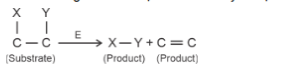 q141_main.png
Identify the enzymes class 'E' from the following options:
Explanation
The reaction shows a substrate with two carbon atoms bearing substituents X and Y, being converted (via enzyme E) into two products: X–Y and C=C (a compound with a double bond). This is a non-hydrolytic elimination reaction that leaves a double bond — the hallmark of Lyases.
- Lyases: Catalyse the removal of groups from substrates by mechanisms other than hydrolysis, leaving a double bond (e.g., decarboxylases, dehydratases, aldolases).
- Transferases: Transfer a functional group between two substrates.
- Isomerases: Catalyse interconversion of isomers (optical, geometric, or positional).
- Ligases: Catalyse the joining of two molecules coupled with ATP hydrolysis (e.g., DNA ligase).
Q142
BiologyEasy
The specific receptors for neurotransmitters in a synapse are present on __________.
Explanation
At a chemical synapse, a neurotransmitter is released from vesicles in the pre-synaptic neuron's knob into the synaptic cleft. The neurotransmitter then binds to specific receptor proteins located on the post-synaptic membrane (the membrane of the next neuron or effector cell), triggering a response.
- Schwann cells provide myelin sheath around peripheral nerve fibres — they do not carry neurotransmitter receptors.
- Pre-synaptic membrane is the site of neurotransmitter release, not reception.
- Myelin sheath is an insulating layer and is not involved in neurotransmitter reception.
Q143
BiologyMedium
What is the probability of having children with 'O' blood group, where both mother and father are heterozygous for 'A' and 'B' blood group, respectively?
Explanation
Mother is heterozygous for blood group A: genotype
Father is heterozygous for blood group B: genotype
Cross:
| (AB) | (A) | |
| (B) | (O) |
Possible offspring:
- → Blood group AB (25%)
- → Blood group A (25%)
- → Blood group B (25%)
- → Blood group O (25%)
Out of 4 children, one has blood group O. Therefore, the probability of having a child with blood group O is 25%.
Q144
BiologyEasy
Match List-I with List-II.
List-I (Respiratory Volume)
A. ERV (Expiratory Reserve Volume)
B. RV (Residual Volume)
C. IRV (Inspiratory Reserve Volume)
D. TV (Tidal Volume)
List-II (Capacity in mL)
I. 2500 – 3000 mL
II. 500 mL
III. 1000 – 1100 mL
IV. 1100 – 1200 mL
Choose correct answer:
Explanation
ERV (Expiratory Reserve Volume) – 1000–1100 mL. RV (Residual Volume) – 1100–1200 mL. IRV (Inspiratory Reserve Volume) – 2500–3000 mL. TV (Tidal Volume) – 500 mL.
Q145
BiologyEasy
Which of following is not example of convergent evolution?
Explanation
Fore limbs of whales and bats: divergent evolution, show homology (same origin, different function). Convergent evolution = unrelated structures, similar function (analogy).
Q146
BiologyEasy
Male frogs distinguished from female frogs due presence of
A. Bulging eyes
B. Vocal sacs
C. Webbed digits in feet
D. Copulatory pad on first digit of fore limbs
E. Olive green-coloured skin with dark irregular spots
Choose correct answer:
Explanation
Vocal sacs + copulatory pad on first digit fore limb → male-specific. Bulging eyes, webbed digits, olive-green spotted skin → common both sexes.
Q147
BiologyMedium
Group of researchers procured fish-like animals, observed characters:
A. Endoskeleton made of cartilage.
B. Ectoparasitic; found attached on fish skin with circular sucking mouth.
C. Paired fins and scales absent, but 7 pairs of gill slits present.
Which species fit best these characters?
Explanation
Petromyzon sp.: cartilaginous endoskeleton, circular sucking mouth, ectoparasite on fishes, no scales/paired fins, 7 pairs (6-15) gill slits. Scoliodon, Exocoetus not parasites.
Q148
BiologyMedium
Match List I (chronology of evolution) with List II.
List-I
A. About 65 mya
B. About 500 mya
C. About 350 mya
D. About 320 mya
List-II
I. Jawless fish probably evolved
II. Dinosaurs suddenly disappeared from earth
III. Seaweeds and few plants probably existed
IV. Invertebrates were formed and became active
Explanation
65 mya – dinosaurs disappeared. 500 mya – invertebrates formed, active. 350 mya – jawless fish evolved. 320 mya – seaweeds/few plants existed.
Q149
BiologyMedium
Match List I with List II.
List-I
A. Progestasert
B. Multiload 375
C. Diaphragm
D. Saheli
List-II
I. Barrier made of rubber used by females
II. Oral contraceptive
III. Hormone releasing IUD
IV. Copper releasing IUD
Explanation
Progestasert – hormone releasing IUD. Multiload 375 – copper releasing IUD. Diaphragm – barrier rubber device, females. Saheli – oral contraceptive.
Q150
BiologyMedium
WBC count of person's blood sample 8000/cu mm. How many eosinophils and lymphocytes approx in same sample?
Explanation
Eosinophils 2-3% total WBC → 2-3% of 8000 = 160–240/cu mm. Lymphocytes 20-25% total WBC → 20-25% of 8000 = 1600–2000/cu mm.
Q151
BiologyMedium
Match List I (Drug) with List II (Effect):
List I
A. Nicotine
B. Morphine
C. Heroin
D. Cocaine
List II
I. Causes sense of euphoria and increased energy
II. Stimulates adrenal gland to release catecholamines into blood circulation
III. Effective sedative and painkiller
IV. A depressant; slows down body function
Explanation
Nicotine → activates adrenal medulla, releases catecholamines (II). Morphine → effective sedative/painkiller, opioid (III). Heroin → depressant, slows body function (IV). Cocaine → stimulant, euphoria + increased energy (I).
Q152
BiologyEasy
Human protein named α-1-antitrypsin, obtained from transgenic animals, used for treatment of ______.
Explanation
α-1-antitrypsin from transgenic animals → emphysema treatment. Transgenic models exist separately for Alzheimer's, rheumatoid arthritis, cystic fibrosis study.
Q153
BiologyMedium
Select set of fishes belonging to class Osteichthyes:
Explanation
Flying fish (Exocoetus), Angel fish (Pterophyllum), Fighting fish (Betta) → marine/aquarium bony fishes. Devil fish (Octopus), Cuttlefish (Sepia) → molluscs. Hagfish (Myxine) → cyclostome. Saw fish (Pristis), Dog fish (Scoliodon) → cartilaginous fishes. Starfish (Asterias) → echinoderm.
Q154
BiologyMedium
Select incorrect statements:
A. Digestive system in Platyhelminthes is incomplete.
B. Bilateral symmetry is characteristic feature of adult Echinoderms.
C. Pseudocoelom is possessed by Aschelminthes.
D. Notochord is persistent throughout life in class Chondrichthyes.
E. Members of class Reptilia maintain constant body temperature.
Explanation
A correct: Platyhelminthes incomplete digestive system. B incorrect: bilateral symmetry → larvae echinoderms, adults radial symmetry. C correct: Aschelminthes have pseudocoelom. D correct: notochord persistent throughout life in Chondrichthyes. E incorrect: reptiles cold-blooded, can't maintain constant body temp (only birds/mammals do). Incorrect: B and E.
Q155
BiologyEasy
Non-membrane bound cell organelles found in both prokaryotic and eukaryotic cells are ______.
Explanation
Ribosome: non-membrane bound organelle, present both prokaryotic and eukaryotic cells.
Q156
BiologyEasy
Which equation depicts Verhulst-Pearl logistic population growth?
Explanation
, where K = carrying capacity, r = intrinsic rate natural increase, N = population density at time t.
Q157
BiologyDifficult
Select incorrect statement w.r.t. Rh grouping.
A. Erythroblastosis foetalis observed having foetus with Rh–ve blood, mother Rh+ve blood.
B. Rh antigen observed on RBCs in majority of human beings.
C. Before blood transfusion, Rh group should also be matched.
D. Rh incompatibility observed when pregnant mother Rh–ve, foetus Rh+ve.
E. Erythroblastosis foetalis avoided by administering anti-Rh antibodies to mother immediately after delivery of second child.
Explanation
A incorrect: Rh incompatibility = mother Rh–ve, foetus Rh+ve (reversed in statement). B correct: Rh antigen on RBC surface ~80% humans. C correct: Rh matched pre-transfusion. D correct: as stated. E incorrect: anti-Rh antibodies given after delivery of first child, not second. Incorrect: A and E.
Q158
BiologyMedium
Match List I (Bioactive molecules) with List II (Importance):
List I
A. Streptokinase
B. Statins
C. Lipases
D. Cyclosporin A
List II
I. Immunosuppressive agent
II. Removal of clots from blood vessels
III. Blood cholesterol-lowering agent
IV. Detergent formulations
Explanation
Streptokinase → clot buster, removes clots blood vessels. Statins → cholesterol-lowering, from Monascus purpureus. Lipases → detergent formulations. Cyclosporin A → immunosuppressive, organ transplant, from Trichoderma polysporum.
Q159
BiologyMedium
Match List I with List II:
List I
A. Molluscs
B. Reptiles
C. Adult amphibians
D. Amoeba
List II
I. Pulmonary respiration only
II. Branchial respiration
III. Cellular respiration
IV. Pulmonary and cutaneous respiration
Explanation
Molluscs → branchial (gills). Reptiles → pulmonary only (lungs). Adult amphibians → pulmonary + cutaneous (lungs + moist skin). Amoeba → cellular respiration (ATP generation).
Q160
BiologyMedium
Sixth mutant codon of beta globin gene causing polymerization of Haemoglobin and change in RBC shape is ______.
Explanation
Sickle cell anaemia: autosomal recessive, Glutamic acid substituted by Valine at 6th position beta globin chain. Base substitution GAG → GUG. GUG codes Valine, responsible RBC shape change.
Q161
BiologyMedium
Choose correct statements regarding muscle contraction.
A. Motor neuron carries signal sent by CNS to sarcolemma of muscle fibre.
B. Neural signal generates action potential causing release of Ca++ into sarcoplasm.
C. Increase in Ca++ inactivates actin for breaking cross bridges.
D. Actin binds to myosin head to form cross bridge.
E. Shortening of sarcomere takes place, pulling actin filaments towards centre of 'A' band.
Explanation
A, B, D, E correct; C incorrect. Acetylcholine release at neuromuscular junction → action potential in sarcolemma → spreads through fibre → Ca++ released into sarcoplasm → binds troponin subunit on actin → unmasks myosin-binding active site → cross bridge formation (not inactivation).
Q162
BiologyDifficult
Which statements correct w.r.t. human endoskeleton?
A. Human skull is monocondylic.
B. Joint between any two adjoining vertebrae is cartilaginous joint.
C. In humans, number of cervical vertebrae is seven.
D. All ribs except last 2 pairs are bicephalic.
E. Occipital bone of skull articulated with atlas vertebra.
Explanation
A incorrect: skull dicondylic (two occipital condyles articulate with atlas). B correct: cartilaginous joints between adjacent vertebrae. C correct: 7 cervical vertebrae. D incorrect: all ribs in humans bicephalic (two articulation surfaces dorsal end), not just excluding last 2. E correct: occipital bone articulates atlas via occipital condyles → atlanto-occipital joint.
Q163
BiologyMedium
Spermatogonia undergo series of cell divisions to produce sperms. Select correct statements:
A. Spermatogonia always undergo meiotic cell division.
B. Primary spermatocytes divide mitotically to produce secondary spermatocytes.
C. Secondary spermatocytes, through second meiotic division, produce haploid spermatids.
D. Spermatids produce spermatozoa through mitosis.
E. Spermatids transform into spermatozoa by spermiogenesis.
Explanation
A incorrect: spermatogonia undergo mitotic differentiation. B incorrect: primary spermatocytes undergo 1st meiotic division (not mitotic). C correct: secondary spermatocytes → 2nd meiotic division → haploid spermatids. D incorrect: spermatids → spermatozoa via spermiogenesis (differentiation, not mitosis). E correct.
Q164
BiologyMedium
JGA (Juxta Glomerular Apparatus) is special sensitive region formed by cellular modifications in _______ related to same nephron.
Explanation
JGA: cellular modifications in distal convoluted tubule + afferent arteriole, at point of contact.
Q165
BiologyMedium
Which is appropriate example of sexual deceit?
Explanation
Female wasp-fig → mutualism. Ophrys-bumblebee → sexual deceit. Sea anemone-clown fish → commensalism. Cuckoo-crow → brood parasitism.
Q166
BiologyDifficult
Choose correct statements regarding frog's anatomy:
A. Hepatic portal system is special venous connection between liver and intestine.
B. Twelve pairs of cranial nerves arise from brain.
C. Ureters and oviducts open separately into cloaca in female frogs.
D. Hind-brain consists of cerebellum, medulla oblongata and optic lobes.
E. Sinus venosus joins right atrium of heart.
Explanation
A correct: hepatic portal system = liver-intestine venous link. B incorrect: 10 pairs cranial nerves in frog (not 12). C correct: ureter + oviduct open separately into cloaca, female frogs. D incorrect: midbrain has optic lobes, hindbrain = cerebellum + medulla oblongata only. E correct: sinus venosus joins right atrium.
Q167
BiologyMedium
Match List I with List II related to embryonic development at various months of pregnancy:
List-I
A. Foetus movement starts and hair appears on head
B. Foetus develops limbs and digits
C. Foetus develops external genital organs
D. Foetus body covered with fine hair; eyelids separate, eyelashes formed
List-II
I. 24 weeks of pregnancy
II. 20 weeks of pregnancy
III. 8 weeks of pregnancy
IV. 12 weeks of pregnancy
Explanation
8 weeks → limbs+digits develop. 12 weeks (1st trimester end) → major organ systems formed, external genitalia developed. 20 weeks (5th month) → foetal movement starts, head hair appears. 24 weeks (2nd trimester end) → fine hair body covering, eyelids separate, eyelashes formed.
Q168
BiologyMedium
In population of grasshopper species, chromosome number some members 23, others 24. 23 and 24 chromosome-bearing members in this species are ______.
Explanation
Grasshopper sex determination XX-XO type. Males: one X + autosomes (XO, 23 total). Females: pair X + autosomes (XX, 24 total). 23 chromosomes → male; 24 → female.
Q169
BiologyMedium
In which animal do haploid cells divide mitotically to produce gametes?
Explanation
Male honeybee haploid, female diploid. Female honeybee gametes via meiosis; male honeybee gametes via mitosis (haploid cell undergoing mitosis).
Q170
BiologyMediumDiagram
Arrange following cell layers/structures around female gamete, outer to inner side:
A. Zona pellucida
B. Perivitelline space
C. Corona radiata
D. Plasma membrane of ovum
Explanation
Outer → inner: corona radiata → zona pellucida → perivitelline space → plasma membrane of ovum. So C, A, B, D.
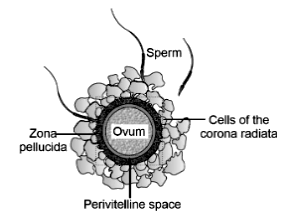 Solution.
Q171
BiologyEasy
What is reason behind production of large holes in 'Swiss Cheese'?
Explanation
Large holes swiss cheese ← large CO₂ from Propionibacterium sharmanii. Clostridium butylicum → butyric acid production. Lactobacillus → curd formation.
Q172
BiologyMedium
Toxin proteins isolated from Bacillus thuringiensis, coded by which genes would control cotton bollworms and corn borer, respectively?
Explanation
Bt toxin genes named cry, insect-group specific. cryIAc + cryIIAb → control cotton bollworms; cryIAb → corn borer. Question pairs cotton bollworm/corn borer respectively → cryIAc and cryIAb.
Q173
BiologyMedium
Ecological pyramids represent relationship between organisms at different trophic levels, generally inverted for:
Explanation
Pyramid of number (grassland) → upright. Pyramid of energy (pond) → upright. Pyramid of biomass (grassland) → upright. Pyramid of biomass (sea) → inverted.
Q174
BiologyMedium
Choose correct statement regarding GIFT to overcome infertility.
Explanation
GIFT (Gamete Intra Fallopian Transfer): in-vivo technique, donor ovum transferred into fallopian tube of female unable to produce ovum but able to support fertilization/development. ZIFT differs: in-vitro, zygote/early embryo (≤8 blastomeres) transferred fallopian tube.
Q175
BiologyMedium
Choose correct statements regarding cell organelles and their inclusions.
A. Endomembrane system includes Golgi complex, endoplasmic reticulum and mitochondria.
B. Rough endoplasmic reticulum bears ribosomes on its surface.
C. Both mitochondria and plastids have circular DNA.
D. Network of microtubules, microfilaments and intermediate filaments present in cytoplasm called cytoskeleton.
E. Mitochondrion is single membrane-bound structure.
Explanation
A incorrect: endomembrane system excludes mitochondria. E incorrect: mitochondria double membrane-bound. B, C, D correct.
Q176
BiologyDifficult
Select correct statements regarding cell membrane in eukaryotic cell.
A. Membrane of human RBCs has approximately 52% protein.
B. Major phospholipids arranged in bilayer.
C. Extensions of plasma membrane into cell form mesosomes.
D. Tails towards inner part of lipids are hydrophobic, protected from aqueous medium.
E. Glycocalyx present on outer surface of plasma membrane.
Explanation
C incorrect: mesosomes formed in prokaryotes (eukaryotes lack). E incorrect: glycocalyx present in prokaryotes (eukaryotes lack). Only A, B, D correct.
Q177
BiologyMedium
Match List I with List II related muscular/skeletal system:
List I
A. Tetany
B. Arthritis
C. Myasthenia gravis
D. Muscular dystrophy
List II
I. Inflammation of joints
II. Autoimmune disorder affecting neuromuscular junction
III. Wild contraction in muscle due to low Ca++ in body fluid
IV. Progressive degeneration of skeletal muscle
Explanation
Tetany → spasms low Ca++. Arthritis → joint inflammation. Myasthenia gravis → autoimmune, neuromuscular junction. Muscular dystrophy → progressive skeletal muscle degeneration (genetic).
Q178
BiologyMedium
Evolution of human appears parallel to progressive development of brain and language skills. Sequence of appearance of individual species:
Explanation
Correct chronological order: Ramapithecus → Australopithecines → Homo habilis → Homo erectus → Neanderthalensis → Homo sapiens.
Q179
BiologyEasy
Flightless bird with forelimbs modified as paddle-like structures suited for swimming known as:
Explanation
Neophron = vulture, Psittacula = parrot; both fly. Struthio = ostrich, Aptenodytes = penguin; both flightless. Penguin forelimbs → flippers, swimming. Ostrich forelimbs → balance running, not swimming.
Q180
BiologyMedium
Choose correct statements regarding population interactions between two species.
A. In both parasitism and commensalism, only one species benefits and other harmed.
B. Both species benefit in mutualism.
C. Both species benefit in commensalism.
D. In parasitism, only one species benefits and other harmed.
E. In amensalism, one species harmed and other unaffected.
Explanation
A incorrect: commensalism → one benefits, other unaffected (not harmed). C incorrect: commensalism only one species benefits, not both. B, D, E correct.